
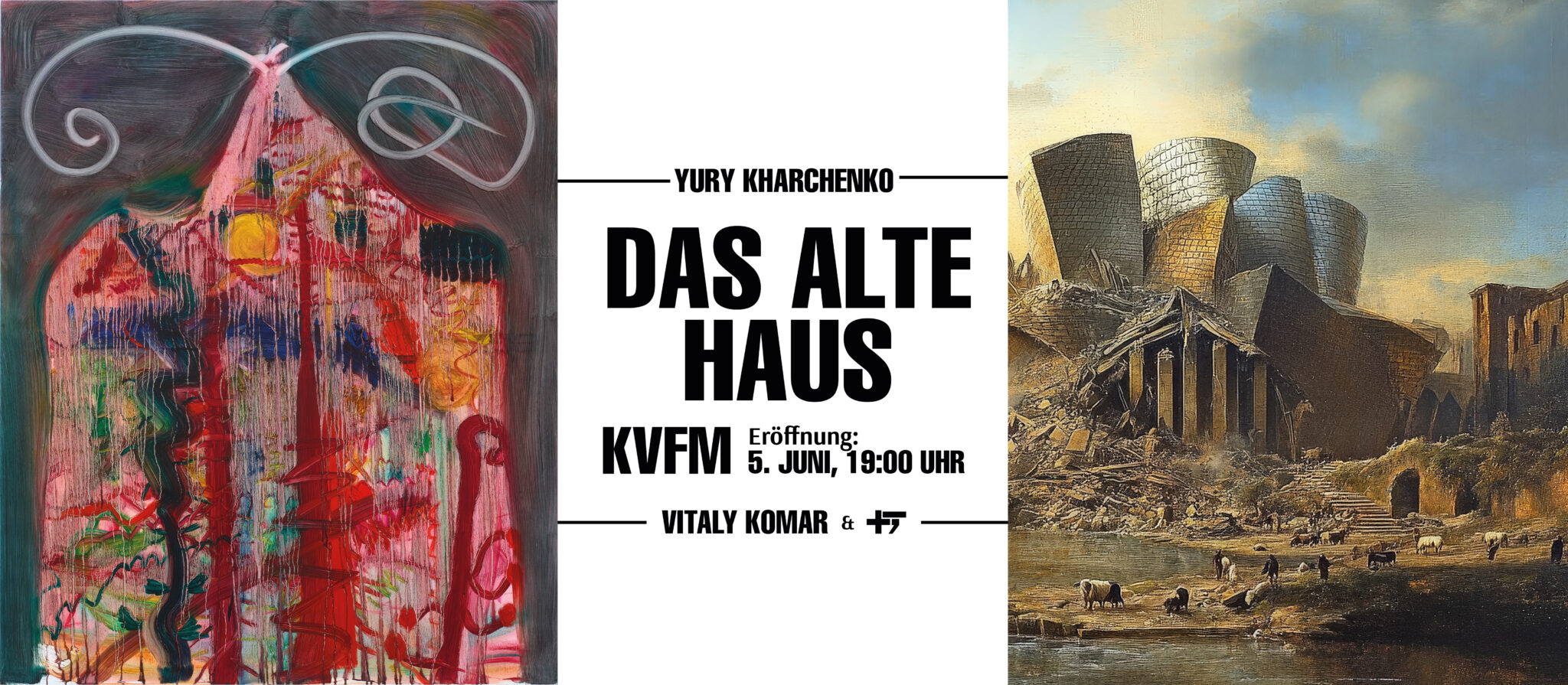
"The Old House": Vitaly Komar and Yury Kharchenko
On June 5, the Kunstverein Familie Montez (KVFM) in Frankfurt will become the stage for one of the year’s most significant artistic discussions. Two artists of the contemporary avant-garde enter into a radical dialogue: Vitaly Komar, a global legend of conceptual art, and Yury Kharchenko, an acclaimed painter. Curated by Marat Guelman, the exhibition "The Old House" examines architecture as the most vulnerable membrane of human existence—a shell wedged between the instinctive need for shelter and the harsh reality of global upheavals.
As part of the exhibition, Vitaly Komar presents his latest project, "Ruins of Museums—Visions from the Future." For the first time, the artist utilizes generative Artificial Intelligence (Stable Diffusion) to calculate the destiny of our cultural monuments. Here, AI acts as a dispassionate oracle, visualizing the probability of cultural decay. Iconic architectural structures such as the Louvre or Tate Modern appear as abandoned skeletons, reclaimed by nature. As theorist Mikhail Epstein notes, the museum, serving as a sarcophagus of time, ultimately becomes its victim. This stands as a visual testament to the failure of the idea of cultural immortality—a technological prophecy reflecting today's skepticism toward centrally managed visions of the future.
Yury Kharchenko’s works are entirely free of cynicism, focusing instead on the physical capabilities of art while exploring the formal and emotional potential of painting. They are simultaneously non-objective—existing as pure visual phenomena akin to sounds—and objective: simple house forms that construct the foundation of the cycle, or silhouettes of figures hidden within the thickets and undergrowth of the dark grid structures of these painterly spaces. Kharchenko’s paintings captivate through their texture and sense of color, stimulating the senses and evoking profound emotions in the viewer.
The two artists differ fundamentally in their approach to the medium. While Yury Kharchenko operates within the field of painting, masterfully exploring its boundaries, Vitaly Komar works with Artificial Intelligence alongside hyper-realistic, futuristic elements. Kharchenko’s houses evoke the acoustics of a chamber concert: initially creating a transcendent, spiritual impression, they remain deeply avant-garde. His house motifs seem to glow from within, conveying a sense of home, security, and warmth, but simultaneously capturing a labyrinthine quest in which the individual constantly returns to themselves. What unites both artists is the conviction that architecture and aesthetic philosophy are inextricably linked, rooted in a system of reciprocal metaphors.
Vitaly Komar (born 1943 in Moscow) is a titan of nonconformist art. Together with Alexander Melamid, he co-founded the Sots Art movement in 1972—a subversive fusion of Socialist Realism and Pop Art that aesthetically destabilized the Soviet power structure. In 1974, he was one of the key initiators of the historic "Bulldozer Exhibition," which was violently shut down by the KGB. Following his emigration to New York in 1978, Komar became the first Soviet artist to receive a grant from the US National Endowment for the Arts (NEA). Throughout his career, he collaborated with figures including Andy Warhol. His masterpieces are held in the world's premier museums, including MoMA, the Guggenheim, and Tate Modern.
Yury Kharchenko (born 1986 in Moscow) is one of the most compelling painters of his generation, consistently charting new territories of artistic practice. In 1998, he arrived in Germany as a quota refugee and studied under Markus Lüpertz at the Kunstakademie Düsseldorf. One of the cornerstone cycles of his oeuvre is the "Houses" series. This cycle has been showcased across numerous institutions, including the Museum Kunstpalast Düsseldorf, the Felix-Nussbaum-Haus Osnabrück, the Kunstmuseum Walter Augsburg, the Kunstmuseum Bochum, and the Hamburger Kunsthalle. His works reside in prominent collections, such as the Museum Kunstpalast Düsseldorf and the permanent collection of the Federal State of North Rhine-Westphalia. He has participated in major national and international exhibitions alongside artists like Gerhard Richter and Anselm Kiefer.
Marat Guelman founded Russia’s first private art gallery as well as the PERMM Museum of Contemporary Art. Due to his uncompromising anti-war stance, he was officially designated a "terrorist and extremist" by the Russian state, labeled a "foreign agent," and placed on a federal wanted list. He is a prominent member of the Russian Anti-War Committee in Brussels. For Guelman, curating is an act of preserving freedom under extreme conditions.




