
The history of the "Ukrainian Transavantgarde" does not begin in 1990 when Marat Guelman brought Ukrainian painters to Moscow, but several years earlier—within a permissive crack that the Soviet system opened for artistic youth in its dying days. As early as the 1970s, the authorities, realizing the impossibility of completely suppressing unofficial trends, allowed the phenomenon of "permitted art"—moderate formal experimentation within official institutions. It was within this logic, riding the wave of Perestroika enthusiasm in the late 1980s, that a phenomenon was born which Kyiv critics would later term the Ukrainian New Wave (Nova Khvylia).
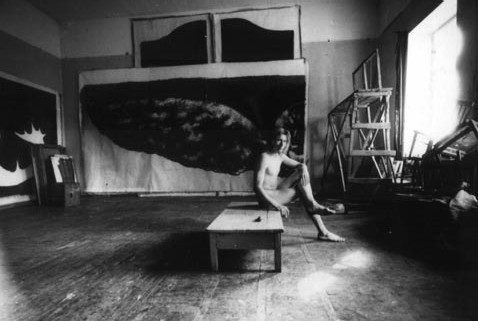
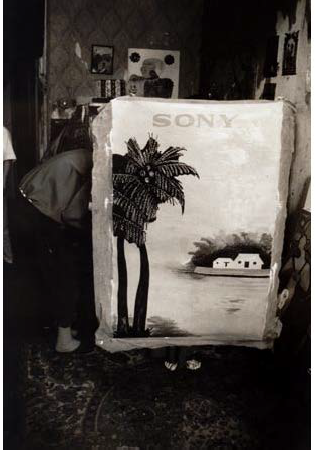
To understand what transpired at the Moscow Youth Palace in 1990, one must first be transported to Kyiv in the late 1980s—to the squatted residential buildings on Sofiivska Street and in the Paris Commune Lane (Parizhskoy Kommuny), which housed the studios of an entire generation of Ukrainian artists from 1989 to 1994. From these squats emerged the elite of Ukraine's contemporary art scene: Oleksandr Hnylytskyi, Oleh Holosiy, Arsen Savadov, Oleksandr Roytburd, Vasyl Tsagolov, Illya Chichkan, Maksym Mamsikov, Illya Isupov, Heorhiy Senchenko, Valeriya Trubina, and many others.
The movement's starting point was the painting The Sorrow of Cleopatra by Savadov and Senchenko, which made waves in 1987—a postmodern paraphrase of Velázquez's Equestrian Portrait of Prince Balthasar Charles. To carry the massive canvas out of their studio, the authors had to break down a doorway.
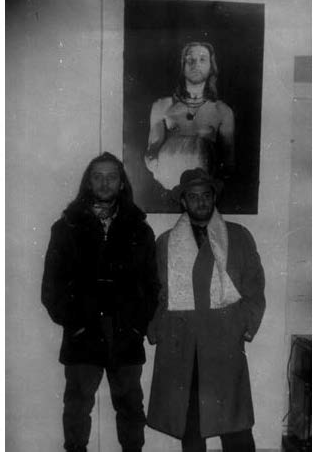
A significant detail clarifying the genealogy of the movement: a considerable portion of the New Wave artists belonged to hereditary artistic clans of the late Soviet system, where the trade was often passed from father to son. Savadov was the son of the well-known book illustrator Volodymyr Savadov; Maksym Mamsikov was the son of the 1970s artist Vladislav Mamsikov; Illya Chichkan was the grandson of a professor at the Kyiv State Art Institute and the son of a Union of Artists member; and Illya Isupov was the son of a monumental artist and the renowned ceramicist Nelly Isupova.
The core of the movement comprised students from the Kyiv State Art Institute, many of whom had previously studied at the Republican secondary art school—a system that trained academic draftsmen from an early age and instilled a reverence for painting as the highest form of artistic statement.
Hence the paradox that art historian Oleksandr Soloviov, author of the essay Sketch on Young Ukrainian Painting, formulated as "Post-Socialist Realism": multi-figure compositions, vibrant color palettes, sweeping brushwork, and gigantic formats were inherited by Ukrainian postmodernism directly from its closest relative—Socialist Realist painting—filling the inherited form with fundamentally new, rebellious content. In a paradoxical way, the dying Socialist Realism gave life to the very art that denied it.
Another term was also used: "Transavantgarde Neo-Baroque." Drawing on the Baroque—one of the most powerful traditions in Ukrainian art history—the painters of the New Wave saturated their canvases with a highly quoted, ornate visuality, earning one phase of the movement the nickname "the curly style." According to Soloviov, the key property of this painting was not technical perfection, but the achievement of pure "vitality"—works were created alla prima, in a single burst of energy, as artists competed over who could complete more massive canvases in a single night.
The movement was not monolithic. Beyond the expressively figurative Kyiv core—Savadov, Senchenko, Oleh Holosiy, Oleksandr Hnylytskyi, Valeriya Trubina, and Vasyl Tsagolov—a somewhat distinct position was held by the group The Volitional Edge of National Post-Eclecticism: Oleh Tistol, Kostyantyn Reunov, Oleksandr Kharchenko, Maryna Skugareva, Yana Bystrova, and Mykola Matsenko. The duo of Reunov and Tistol, with their programmatic work The Volitional Edge of National Post-Eclecticism, stood at the origins of the Ukrainian version of the Transavantgarde alongside The Sorrow of Cleopatra.
The geography of the movement was not limited to the capital: starting in 1987, artists from Odesa joined the painting circle—Vasyl Ryabchenko, Serhiy Lykov, Zoya Sokol, and the future leader of the Odesa New Wave, Oleksandr Roytburd—as well as Pavlo Kerestey from Uzhhorod and Andriy Sahaidakovsky from Lviv.
                      GENEALOGY OF THE NEW WAVE (1987–1990)

   KYIV SQUATS (Paris Commune)         ODESA & REGIONAL CIRCLES
   ───────────────────────────         ────────────────────────
   • Savadov & Senchenko               • Oleksandr Roytburd
   • Oleh Holosiy                      • Vasyl Ryabchenko
   • Oleksandr Hnylytskyi              • Serhiy Lykov
   • Valeriya Trubina                  • Pavlo Kerestey (Uzhhorod)
   • Vasyl Tsagolov                    • Andriy Sahaidakovsky (Lviv)
   • Tistol & Reunov ("Volitional Edge")
It was precisely at this intersection—where Ukrainian painterly freedom met the nascent Moscow art market—that the encounter described by Marat Guelman took place. Meeting Oleksandr Roytburd at the 17th All-Union Youth Exhibition prompted Guelman to travel to Kyiv and Odesa.
"I made the final decision to actively collect the works of Ukrainian artists in 1988, after the famous Sotheby's auction in Moscow, which sent art prices in Russia skyrocketing," Guelman recalled. "I realized that the artists I had been collecting until then were no longer interesting to me, and those who were interesting had become financially unattainable."
Guelman’s account of his first visit to Kyiv exposes the cultural gap into which he stepped:
"The works of Ukrainian artists from the early 1990s look today like an apology for painting. If today one often hears that 'painting can also be contemporary art,' it is hard to imagine a better defense than the works of Roytburd, Savadov, Senchenko, Hnylytskyi, Holosiy, Tistol, Tsagolov, and Kerestey. In the 1990s, the primary difference between Russian and Ukrainian art was the attitude toward painting itself.
When I first arrived in Kyiv after the 17th Youth Exhibition, I had a list of artists I wanted to meet. I arrived early in the morning and, while waiting for the evening, went to an exhibition of the official Union of Artists. To my horror, I saw paintings signed with the very last names of the artists I was planning to visit that night! Still lifes, landscapes, genre scenes—everything I actively disliked. That evening, it turned out those were their fathers.
In Moscow, 'official' and 'unofficial' artists were not merely on opposite sides of artistic barricades—they were personal enemies. It was impossible to use the language of painting simply because it was used by your opponents, the 'official' artists who destroyed undesirable exhibitions and sent bulldozers against them.
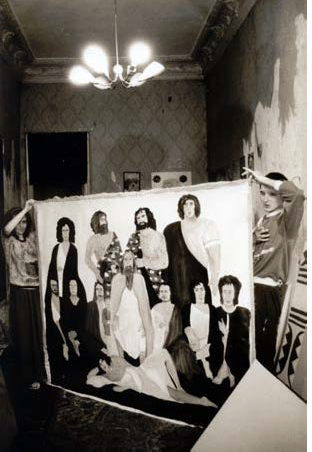
In Kyiv, the situation was completely different: you would go to Reunov's or Savadov's home, and sitting at the same table were artists from the official exhibition alongside avant-garde artists. They communicated wonderfully and appreciated each other's art. It was a totally different atmosphere. It seems to me that the absence of personal confrontation between late-Soviet art and the new art—the absence of a 'prohibition on painting'—allowed the Ukrainian Transavantgarde, or the South Russian Wave, to develop.
Furthermore, I had a sense of generational unity. We were new people: they were new artists, I was a new producer, and we shared a common objective. This generation of Ukrainian authors were either my peers or slightly younger, and we established an instant rapport. While my early stages of self-education came from books or lectures, the Ukrainians gave me the joy of not just being a collector of art objects, but of immersing myself in artistic life. I traveled to Kyiv almost weekly, to their squat on Paris Commune Street, communicating constantly. It was a rich life. It was with the Ukrainians that I first felt part of an artistic scene.
So all the money I earned, I invested in collecting mostly Ukrainians. For two years, it seemed no one else seriously bought or supported them. Many artists—Hnylytskyi, Holosiy, Roytburd, and to an extent Savadov, Senchenko, and Tsagolov—had the opportunity to work peacefully for two years because I was building this collection. In 1990, this culminated in the exhibition 'Babylon: South Russian Wave.' It was my first exhibition as a curator; prior to that, I had only managed solo projects for individual artists. The history of my gallery began with that exhibition.
I donated a significant portion of the works to the State Russian Museum, which at the time, thanks to curator Alexander Borovsky, was the only museum in the country systematically collecting contemporary art. Part remained with me, and part was sold to leading museums worldwide.
All the works were huge. I kept the ones of more human dimensions, while the large ones went to museums. I have a theory as to why they painted such massive canvases. Their paintings, due to their painterly richness, were accessible to the general public; the intelligent, subtle works of Hnylytskyi or Holosiy could appeal to both professional connoisseurs and laymen alike. The lay public liked that rich, impasto palette of browns and yellows. Thus, there was a danger of commercialization.
So the artists made them huge so they wouldn't be bought. It was their way of remaining non-commercial. Hnylytskyi's 'Wing'—it would have been bought a hundred times over before the exhibition opened if it hadn't been seven meters long. How many times was I asked, 'Can he make a smaller one?' Savadov and Senchenko's giant 'Monkeys' stayed in Russia, at the State Russian Museum, to which we donated them. I see no other explanation. After all, the artists didn't have the space for these works; they lacked proper studios. Holosiy—who utterly fascinated me—painted works in sections according to a sketch. He would take one section off the stretcher, stretch the next, paint the second, then the third, and only later join them together. They were, of course, remarkably talent gifted plastically."
                       THE "BABYLON" EXHIBITION (MOSCOW, 1990)

   SPATIAL CONCEPT                CURATORIAL STATEMENT           KEY PARTICIPANTS
   ──────────────────────────     ───────────────────────────    ─────────────────────────────
   Held at Moscow Youth Palace.   Rejected underground binary    • Kyiv: Savadov, Senchenko,
   Gathered painters from Kyiv,   logic (official/unofficial);    Holosiy, Hnylytskyi, Trubina.
   Odesa, and Moldova in a        presented a unified, post-     • Odesa: Roytburd, Ryabchenko.
   single physical space.         Soviet aesthetic agenda.       • Moldova: Khorovsky, Bakhchevan.
By 1990, the idea of showing Ukrainian artists in Moscow was in the air, and Guelman was not the first to conceive it. According to recollections by Oleksandr Roytburd recorded in 2007, the first attempt to organize a Ukrainian exhibition in Moscow was made by Kostyantyn Raevsky, who tried to push the project through critic Leonid Bazhanov, but the initiative stalled. Guelman then proposed a similar idea, inviting his entire "team"—Hnylytskyi, Holosiy, and Holosiy's wife Valeriya Trubina, whom Roytburd called the muse and favorite of the entire circle. Joining the Kyiv core were Tistol, Reunov, Yana Bystrova, Kerestey, Panich, as well as several Odesa artists—Ryabchenko, Lykov, and Nekrasova.
The exhibition opened at the Moscow Youth Palace in 1990. Formally, it was Guelman's first group exhibition as a curator. The organizational text declared a fundamental departure from the logic of previous underground showcases: unlike earlier exhibitions that illustrated the underground, Babylon did not set out to build an antithesis to official art.
This was a fundamental formulation: the exhibition deliberately moved beyond the Soviet binary logic of "official vs. unofficial," offering instead a completely new, post-Soviet artistic agenda—the very logic of peaceful coexistence between generations and schools that Guelman had observed in Kyiv and found lacking in Moscow.
The title Babylon was precise in meaning: painters from different cities and with different artistic temperaments gathered on a single platform—the Kyiv Neo-Baroque of Hnylytskyi and Holosiy, the ironic quotations of Tistol and Reunov's Volitional Edge, the Odesa line of Roytburd and his compatriots—people who had rarely crossed paths before and who spoke about a shared artistic field for the first time at this exhibition.
The reaction was mixed. Guelman later called this exhibition the first truly successful one in his career, noting that nobody remembers the unsuccessful ones. Yet the skepticism of the Moscow public toward Ukrainian art was vast: in a capital dominated by Romantic Conceptualism, any figurative painting was viewed with suspicion, perceived as a mark of the official Union of Artists. Decades later, Roytburd characterized the exhibition's impact with a cautious phrase: "The 'Babylon' exhibition defined the contours of the future Guelman Gallery, though it had no immediate positive reaction."
One Moscow artist, however, reacted unambiguously—according to Guelman's memories, he danced a hopak right at the preview as a sign of recognition, an emotional outburst Guelman called the ultimate sign of success.
The significance of Babylon extended far beyond the Moscow context. It was at this exhibition that the works of Valeriya Trubina and several other young Kyiv painters caught the eye of Scottish art historian Andrew Brown, who had founded Gallery 369 in Edinburgh in the 1980s as a launchpad for young artists.
In 1993, Brown traveled personally to Kyiv and invited a group of artists—Trubina, Savadov, Senchenko, Roytburd, Hnylytskyi, and Chichkan—to participate in the landmark Edinburgh project Angels Over Ukraine, held in an Apostolic Church.
For Trubina, the trip proved life-changing: after the project ended, the organizers invited her to stay for a residency in Scotland, where she painted her famous series featuring mysterious gardens and twilight parks. These works, along with canvases by Holosiy from Brown's personal collection, were later exhibited at The Economist magazine’s space in London under the project New Ukrainian Painting — After The Apocalypse. Thus, a single exhibition initiated a chain of events that launched Ukrainian painters onto the European stage without any Moscow mediation.
                    THE INTERNATIONAL TRAJECTORY (1990–1993)

 [ Moscow: "Babylon" (1990) ] ──► [ Edinburgh: "Angels Over Ukraine" (1993) ]
                                              │
                                              ▼
 [ London: "After The Apocalypse" ] ◄── [ Scottish Art Residency ]
A significant portion of the works collected by 1990 was later donated by Guelman to the State Russian Museum in Saint Petersburg—thanks to curator Alexander Borovsky, it was the only museum in the country systematically collecting contemporary art at the time. The collection fund South Russian Wave from the Collection of Marat Guelman included around sixty works—by Roytburd, Holosiy, Solomko, Khorovsky, Hnylytskyi, Tistol, Hankevich, Migas, Savadov, and Senchenko. Part of the collection remained with the collector, while part went to leading international museums. Yet as Guelman admitted, many paintings of that generation bypassed museums entirely, ending up in private hands abroad and vanishing from cultural rotation, preserved only on low-quality slides.
It was after Babylon that the term "South Russian Wave" stuck in Moscow art criticism for the Kyiv-Odesa circle—in contrast to the "Northern," conceptualist school. Early critical essays on this art were penned by Ekaterina Degot, Andrey Kovalev, and Vladimir Levashov.
With Ukraine gaining independence, the term—bearing an overt imperial connotation—gradually fell out of use in the artists' homeland, where their own name took root: "Nova Khvylia" (New Wave), consolidated by curator Oksana Barshynova’s exhibition at the National Art Museum of Ukraine in 2009. Guelman himself, acknowledging the flavor of the label, explained it not by imperial ambitions, but by the fact that alongside Ukrainian artists, two Moldovan creators—Yury Khorovsky and Valentina Bakhchevan, who were drawn to the Kyiv circle—also participated. Nevertheless, the Ukrainians themselves, in his words, proved the most vibrant and defined the face of the phenomenon.
Decades later, academic historiography took up the reevaluation of this heritage: researcher Alisa Lozhkina, in her foundational work Permanent Revolution, reconstructed the movement's genealogy without nostalgic polish, while curator Ekaterina Degot returned to the topic in her project YAKSHCHO (IF), presenting the same artists as part of a broader European Transavantgarde.
It is revealing that Guelman traces the history of his gallery directly to Babylon—prior to that, there were only private collecting activities and individual solo projects. In 1990, the same year as the exhibition, his gallery on Malaya Yakimanka was founded. Years later, looking back at a quarter-century of activity encompassing around five hundred exhibitions, Guelman called the "South Russian Wave" the first of several defining projects of his career, alongside Russia-2, the Unofficial Moscow festival, and Russian Poor—milestones that occurred roughly once every five years.
Thus, Marat Guelman's private collecting venture of the late 1980s became woven into a much broader, autonomous narrative: the birth of post-Soviet Ukrainian artistic modernism, whose historiography today is written without looking back at how the phenomenon was once labeled in Moscow.


