
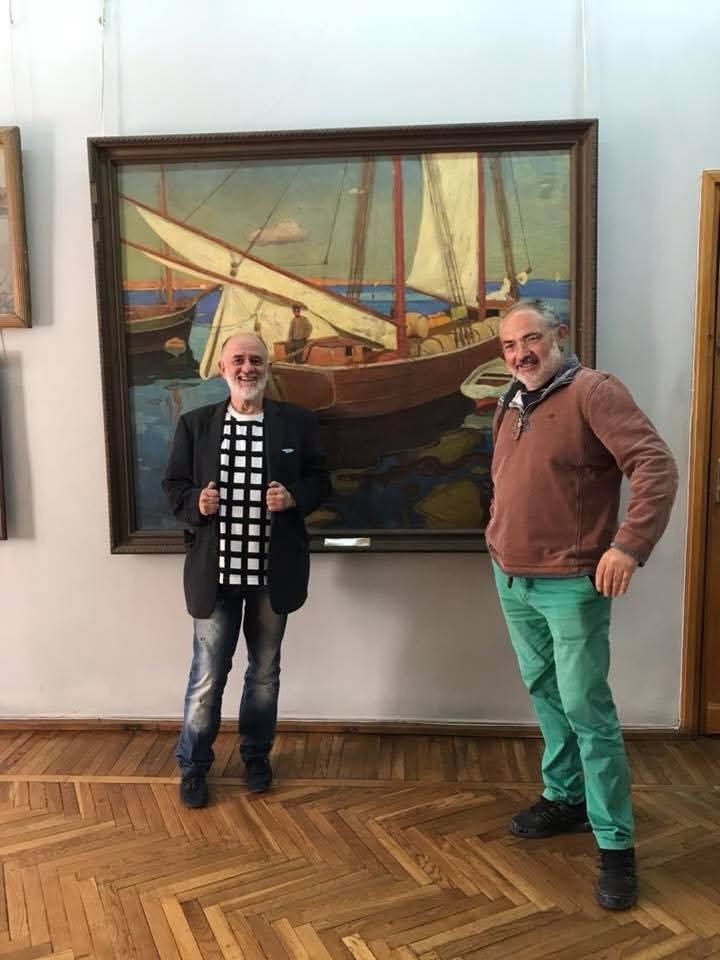
Marat and I met in 1988. At the time, I was staying in Moscow at the apartment of Tania Salzirn, a friend of my wife. The phone rang, and Tania answered someone: "Oh, he's actually sitting in my kitchen right now." Then she handed me the receiver and commented: "Listen, Marat Guelman wants to meet you." I asked: "Who's that?" She replied: "You know, he's a sponsor." I should mention that back then, in the mouth of a young woman, that word carried a somewhat different meaning than it does today. Back then, it meant art.
As I understand it, Marat remembered my surname thanks to my participation in the famous All-Union Youth Exhibition at the Manege. The most "radical" section there was represented by Georgians, Baltics, and Ukrainians—among the Ukrainian submissions were The Sorrow of Cleopatra by Savadov and Senchenko, and my own triptych. Andrei Reuter was also there with his piece The Cup.
To make it into that exhibition, I had to pass through three exhibition committees—in Odesa, Kyiv, and Moscow. The Odesa exhibition committee didn't pass a single one of my works for Kyiv. Mockingly, they allowed me to display only the right-hand panel of one triptych, which was framed together with the other two parts. So my wife stitched a giant sack for me; I grabbed about ten paintings and three series of graphics, and took them to Kyiv myself. There, to my surprise, they exhibited everything I brought—even though they were only taking either three paintings or one graphic series from each participant. I became a star and got my "fifteen minutes of fame"; about fifty people approached me that day to introduce themselves. I, in turn, went to introduce myself to Arsen Savadov.
Then came the Manege.
Marat and I agreed over the phone to meet the next day near the Kropotkinskaya metro station, not far from where he lives now. And we met. It was autumn; Marat was wearing a trench coat, I was wearing a trench coat, leaves were rustling underfoot. We walked along Gogolevsky Boulevard, discussing art. Marat spoke about his collection—he owned a lot of Anatoly Zverev, Kazarin, and Moldovan artists, of whom I only knew the artist Bakhchevan from the album Young Artists of the 70s. I, in turn, spoke about Odesa and invited him to visit me.
A month later, Marat was in Odesa. He came for two days and looked at my work. He looked and looked, and on the second day, as he was preparing to leave, he said: "Listen, usually artists offer me things, but you stay quiet and force me to make you an offer myself." I said: "Make it." Marat remarked that I was a good businessman (though I think he was mistaken). He chose one painting to buy and asked me to bring a dozen works to Moscow. Two weeks later, I delivered paintings to Moscow on which the paint hadn't even dried yet.
From then on, I established a rough schedule: I would spend two weeks painting in Odesa, then go to Kyiv for three days, then to Moscow for a week, then back to Kyiv for three days, and return to Odesa. A train ticket to Moscow cost twenty rubles, and to Kyiv—ten. It turned out that every month I spent half my time at home, and the other half between Moscow and Kyiv.
At that time, an internal conflict lived inside me. On one hand, I knew how to paint and loved doing it; on the other, I was friends in Odesa with Seryozha Anufriev, Yura Leiderman, Lenya Voytsekhov, and other participants of the "Odesa Group." Their ideology was much closer to me than the one my painting inhabited. Yet I couldn't bring myself to abandon the painterly drive and expressiveness. Arsen Savadov helped me reconcile those two sides. It’s funny that despite the vast difference in the artistic output each created, Savadov and Anufriev, upon meeting—an encounter I had the pleasure of witnessing—discovered numerous intersections in ideology and even terminology, peculiar as it was to both of them.
Savadov reconciled painting with conceptual thinking inside me, closing the gap that existed between them. I already mentioned meeting him at the opening of the youth exhibition in Kyiv in 1988. I simply fell in love with Kyiv back then, meeting a mass of talented, friendly, and open-minded people.
About six months later, new authors declared themselves—still students—among whom was Sasha Gnilitsky, who made a profound impression on me immediately. I remember how his wife at the time, Natasha Filonenko, worried terribly that Sasha was drinking himself away alongside the "wild boy" Oleg Golosiy. I also remember my own puppy-like enthusiasm upon discovering Golosiy's work.
I began bending Marat's ear: Moldovans are great artists, of course, but in Kyiv, in Kyiv... In the end, I brought Marat to Kyiv and introduced him to my friends. Marat first expanded his team of artists, and eventually the Ukrainian artists squeezed out the Moldovans. He also had intimate Moscow artists—Basanets, Medvedev... Andrei Basanets was Marat's closest friend among the Moscow painters. I had met Andrei about three years earlier when he came to Odesa alongside Vladimir Sorokin. But to this day, I remain convinced that among the entire variety of Marat's collection at the time, the Ukrainian artists were the most compelling.
Our meetings with Marat mostly happened in Odesa or Moscow. We were close friends back then and constantly discussed the concept of a contemporary art gallery. In the spring of 1989, I arrived in Moscow. There was near-famine there; many products were sold only on ration coupons. Notices in building entrances read: "Butter is sold in the same shop as sugar." Visiting foreigners were baffled: "So what? In our countries all food is usually sold in one shop too."
Anyway, it was spring, Passover, and Marat asked me to bring matzo from Odesa. I brought two boxes of matzo, Marat had a crate of vodka at his apartment, and Basanets had a three-liter jar of pressed caviar. And nothing else! That's how we lived for several days: spreading caviar on matzo and washing it down with vodka. In an old Soviet film, a German officer curses: "You flighty Bolshevik Cossacks!"—that was probably us.
First came Babylon. In principle, all Ukrainian artists understood the need to exhibit in Moscow. Valentin Raevsky made the first attempt, pushing the idea of a Ukrainian exhibition through Bazhanov, but it stalled. Then Marat came forward with a similar proposal and invited his entire "team" to participate: Gnilitsky, Golosiy, and Golosiy's wife, Lera Trubina. Lera was our muse and favorite. She and Golosiy separated a few months before his death; later she left for America and now lives somewhere in Hawaii.
There were other Kyivans too—Tistol, Reunov, Yana Bystrova, Kerestey, Panich. And a few Odesans—Ryabchenko, Lykov, Nekrasova.
The Babylon exhibition defined the contours of the Guelman Gallery, though it didn't trigger an immediate positive reaction. Marat showed everything personally dear to him: the Moldovans, the intimate Moscow painters, and the Ukrainian New Wave—so it lacked cohesive unity. Perhaps due to its eclectic nature, some Kyivans—like Savadov, Senchenko, and Raevsky—refrained from participating.
Critics reacted to Babylon with benevolence, sometimes bordering on enthusiasm. But artists from the "Noma" circle saw in our works only "painting," which by "Nomad" standards was taboo by definition. We invited Dmitry Alexandrovich Prigov and Seryozha Anufriev to the opening. Prigov famously remarked with caustic wit that the Ukrainian language allegedly lacks the word for "artist"—in Ukrainian, an artist is a malyar (house painter)—and that this exhibition was sheer malyarstvo (house painting). And Anufriev—I was ready to kill him right there—said that looking at such art made him want to dance a hopak. And he danced it. From the Muscovites, it was a deliberate put-down.
They lumped us almost into the "Left MOSKh" [Left Wing of the Moscow Union of Artists] circle, even though we possessed an entirely different intellectual foundation. For instance, the Georgian neo-abstractionists who emerged on the Moscow scene simultaneously with us, like Gia Edzgveradze, were doing something entirely different from what Moscow understood as abstract painting.
I think much of it was fear of competitors. Despite that, I consider Babylon a successful project. From today's perspective, the entire exhibition consisted if not of masterpieces, then certainly of hits. And everything was created rapidly—Golosiy could paint two canvases measuring two by three meters in a single night. I envied him terribly because painting one such picture took me an entire day. I don't understand where that energy came from—it wasn't just age, but the very air of those years. Something was driving us, forcing us to work, instilling a desire for expansion.
Ilya Tsentsiper recalled Babylon hilarousely while lying next to me and Savadov on a Sochi beach: "Back then in Moscow, we were terrified of the southern invasion. We bent over preemptively, thinking: 'Well, now you're going to screw us all.' And you provincial idiots thought that bending over was the latest capital fashion, so you got into the exact same pose. That's when we got you..."
Nine months later, Marat opened his gallery.
On one of my visits, Marat announced: "I've decided to open a gallery. Thinking of calling it the Guelman Gallery." Back then, it was customary to invent fancy names for galleries, sounding like cooperative cafés. Then he invited me to stage the inaugural exhibition.
The gallery was located in an old building near the Center for Contemporary Art on Yakimanka. Marat painted the walls with emulsion paint, but it wasn't a "European-style renovation"—it was more of an "Afro-renovation." In the middle of the room stood an un-dismantled stove, the windows were covered with particle board, and "scarce" Baltic lighting fixtures hung from the ceiling.
Painting held the dominant position back then—video as an artistic medium appeared in Moscow about four years later. At the time, VCRs weren't in every home, let alone cameras. Everyone frequented "video-cafés" to eat borscht while watching Nine ½ Weeks or The Night Porter. It was considered a fashionable pastime.
The circle of artists Marat worked with shifted over time. From the original group, only Andrei Basanets remained, though he changed too—switching to "finger painting." From the Moldovans came Yura Khorovsky, who became practically a "Kyivan" in style. I actually preferred his earlier papier-mâché works. The Moldovan abstractionists vanished entirely. Thus, Marat's second phase of enthusiasm after the "Moldovan" period can be called the "Ukrainian" phase.
I recently read Marat's post on LiveJournal claiming I never introduced him to the Martynchik duo in Odesa. How could he forget? I took him to meet them several times! The first time, they told us to bugger off and wouldn't even let us past the threshold. Gosha said: "You bring a man over without a bottle, damn it!" The second time, they talked, but nothing came of it either—even though we brought a bottle—because there were issues with Marat's horoscope once his birth date was revealed. Only on the third attempt did I manage to stick them together, which delighted me. That was around 1992.
Later, artists like Ter-Oganyan, Koshlyakov, the AES Group, and Brener entered the fold. I remember Brener and Osmolovsky's performance at the Manege. Brener was howling loudly, and Tsentsiper said reproachfully to Piganov: "You see, Ilyusha, when you get drunk, you behave just as unsightly." Tania Arzamasova remarked that she had wondered for a long time whom Maratik would allow to drop their underpants first. And Piganov expressed immense gratitude to Brener: now that he had exposed his ass and dick, that problem in Russian art could be considered closed, and thank God he, Piganov, didn't have to do it himself anymore.
In 1993, my final exhibition at the Guelman Gallery took place. It was titled Portrait. Ladies. In White. and spanned three exhibition spaces simultaneously: Levashov showed collages, Guelman showed paintings, and Ira Piganova showed retouched photographs. Volodya Levashov devised the idea of printing a booklet cut into three parts—so a viewer could assemble the complete booklet only by visiting all three venues. Marat reluctantly agreed, but remained dissatisfied.
After that exhibition, Marat and I sat on a bench near the Dimitrov monument, and against the backdrop of the statue's obscene gesture—a fist thrust upward—I laid into Marat. The bone of contention was the Moscow Conceptualists, some of whom I was friends with and wanted Marat to represent. Granted, "Noma" was a Soviet-style sect, which was terribly irritating. Nevertheless, I believed working with the Conceptualists was paramount. Marat refused to approach them with proposals, believing that in time they would come to him on their own. Time proved him right, but at that moment, something else mattered to me.
The exhibition Portrait. Ladies. In White. was my protest against a gallerist's "private ownership" of an artist. For instance, as soon as Vladimir Ovcharenko started working with Golosiy, he immediately made it a condition that Golosiy sever ties with Guelman.
My Moscow circle at the time, besides Marat, consisted mostly of critics—Kosta Akinsha, Katya Degot, Volodya Levashov, and Andrei Kovalev. Among artists: the AES Group, Leiderman, Seryozha Anufriev, Arkasha Nasonov, Vladik Efimov, Ilya Piganov, and his wife Ira, the gallerist. And many others.
Even before the Trekhprudny Lane circle, I became friends with Ter-Oganyan and Koshlyakov. I remember Yevzovich and I going to meet Avdei and stumbling into a drinking session. There I saw Sasha Mareev's early works—large, expressionistic monochrome portraits of French encyclopedists, executed masterfully! It felt as though if not a new genius, then an artist with a massive future had arrived. Later, Mareev became deeply acquainted with psychedelic discourse, and his future turned out far more modest...
Starting in 1993, I became consumed by the idea of establishing the Kingdom of God in Odesa, leaving no time for Moscow. In 1995–1996, when everything in the capital stalled for a while, we executed a series of strong projects in Odesa. Seryozha Anufriev played a deeply positive role in this; it was the period of our greatest mutual affection. I remember bringing video footage of those exhibitions to Moscow and showing it to Ira Piganova. She said: "So you plugged the hole we got sucked into here in Moscow all by yourself with your ass!" It felt as though for a time, Odesa became artistically more compelling than Moscow and Kyiv. And though I probably missed out on a lot career-wise during those years, I don't regret it.
In 1994, Marat nearly opened a gallery branch in Odesa with curator Ute Kilter as his partner. It lasted a few months.
When I resolved to work as a curator in Odesa, I established a non-profit organization. Unlike the Guelman Gallery, it survived on grants and sponsor funding. In 1997, the Soros Center for Contemporary Art in Odesa was opened on its foundation. It existed until 2000. Then random people came to power at the SCCA. I lost my temper and left for America; a few months later, Misha Rashkovetsky left as well. The new management managed to destroy everything we had built for years. I returned eight months later—not a trace of artistic activity remained in Odesa.
In 2002, returning from another trip to America, I attended a friend's birthday party. Suddenly the apartment phone rang, and a sweet female voice, instead of wishing the host a happy birthday, announced: "Calling from Marat Guelman's office. Is Alexander Roitburd there?" The birthday boy handed me the phone, and Marat offered me the position of director at his gallery in Kyiv. I accepted with pleasure, as it represented a sensible alternative to both New York—where I felt uncomfortable—and Odesa, where I felt too comfortable.
I was granted complete freedom. All decisions regarding the exhibition program were reached by consensus—Marat imposed nothing and forced nothing. Two-thirds of the exhibitions featured local artists, and one-third featured Muscovites—such as Ostretsov and the Blue Noses. Russian artists also participated in group projects like Xenophilia (which included works by the AES Group and Ira Waldron).
I engaged in virtually no commercial activity, because in Kyiv my connections were mostly within the artistic community, with no access to the business elite like in Odesa. Marat resolved to orient the gallery not toward small collectors, but toward organizing Viktor Pinchuk's museum of contemporary art.
We must admit that this project failed, even though Pinchuk eventually created his museum. There were many reasons. I hope that over time, Pinchuk will come to appreciate what we offered him. The project could have become for Ukraine what the Tretyakov Gallery was for 19th-century Russia.
The Guelman Gallery team—Alisa Lozhkina, Sasha Solovyov, and myself—executed a truly titanic volume of work in an unrealistically short timeframe. We sifted through the last fifteen years of Ukrainian art, including overlooked movements. Our list included Medical Hermeneutics, Lviv natives like Filatov and the Kopystianskys, and Kharkiv artists like Mikhailov and Bratkov... It was a broad cross-section of contemporary art featuring exceptional works. But when we submitted the budget, Pinchuk deemed the prices inflated—even though today, the works in that proposal have appreciated several times over. In the end, Pinchuk acted like a classic grandee from the era of Catherine the Great: he hired a French curator...
The primary issue is that Pinchuk, it seems to me, sometimes perceives a museum as just another division of his holding company—alongside his pipe-rolling mill, ore-dressing plant, and television channel. Yet culture demands an entirely different management model: it requires publicity, transparency, a degree of aggression, and a conqueror's ambition. Marat began precisely that way—with open discussion and a conference gathering virtually the entire Ukrainian art community. For better or worse, the current concept of the Viktor Pinchuk Foundation bears little resemblance to what Guelman proposed.
I have a limited grasp of Marat's political activities in Ukraine, but I know for certain that the Guelman Gallery pursued zero political objectives. Everything the gallery accomplished in Kyiv exerted a deeply beneficial influence on the Ukrainian art scene. It served as the primary forum for contemporary art. Now that it has closed, no one has filled that vacuum.
The Orange Revolution brought positive shifts to the Ukrainian economy and politics, but affected contemporary art far less favorably. Kuchma was completely indifferent to art, thank God. Yushchenko, unfortunately, possessed his own cultural obsessions. He collects folklore and artifacts, paints, shapes pottery, and carves wood...
Recently, Oleg Tistol and I sat discussing politics, and Oleg said to me: "Look, we're having political debates right now while Yushchenko is probably painting... It should be the exact opposite—we should be painting while he minds his own business."
But that belongs to the post-Guelman history of Ukrainian art...



