
Yesterday, I read through my discussions from 20 years ago regarding the Russia 2 exhibition. I considered it a success, despite the immense amount of criticism it received—more than usual. It was mostly slammed by the Right. Nika Dubrovskaya schematically dubbed them "Nalbandyan lovers," and the label stuck, even though they took offense. They argued, "We love Cézanne, but we don't like Nalbandyan." I responded, "Well, you are criticizing me 'incorrectly' too." When it comes to my own persona, I only ever hear schematic definitions. But why be offended? Nobody is actually interested in who you really are and what you want. The general vector is clear: Conservative vs. Modernist, Right vs. Left. You either love Cézanne or Kabakov. I love Cézanne too. But (to be honest) I love Kabakov more. He is my contemporary and he speaks to me. My personal involvement with art is intertwined with him, among others.
Yet, both Cézanne and Kabakov were used as clubs against me at various times. Up until 1994, the Moscow art scene kept pointing out to me that nothing outside of NOMA and Moscow Romantic Conceptualism could be considered contemporary Russian art.
As for Cézanne, everyone used him to bash "contemporary art." He created the canon of "painting as such," which is why he is great. On the other hand, out of all the Impressionists, Cézanne proved to be the most adapted to the Soviet coordinate system. He symbolized the maximum permissible distance one could veer left from realist painting. The mindset was: Cézanne is still art; anything beyond that is the devil knows what. "Cézanne-ism" was the favorite pseudo-style of the left wing of the Moscow Union of Artists (MOSKh). That is probably why I love him less. Generally, this is a problem—having too many students and followers. A superficial following in the footsteps of... This is how numerous and fierce fans discredited Dalí, and how they are currently discrediting Warhol. In recent Russian art, Shmyakin discredited the visual language of Shvartsman.
Broadly speaking, I have nothing to argue about with the Right. Yes, the idea of progress in art does not work. The history of art is not always a forward movement, but... conservatism as a strategy is only possible if everyone around you is a modernist. And it must be placed in quotation marks. Meaning, David Hockney and Lucian Freud are true conservatives, whereas those who criticize me from the Right are, at best, third- or fourth-rate Cézanne-ists.
But arguing with the Left—now that is something we love to do. That being said, I classify the "Left" into several categories:
By the way, here is an interesting observation. While the Right appeals to art ("art must... otherwise it is not art"), the Left appeals to the artist ("the artist must... otherwise he is not an artist"). In other words, for one group, the object is more important; for the other, it is the process. A gallerist is always looking for both. Meanwhile, artists most often say: "We don't owe anyone anything, we are simply engaged in self-discovery," or "We just do what we find interesting and deem important." Then there is a fourth group that says: "It isn't us. Something else (time, class, a generation, God) is speaking through us, and we are merely instruments." The gallery collaborates with all "types" of artists, provided I find the result convincing. However, it is precisely this demand for results and success that constitutes the main grievance leveled against me by both the Left and the Right.
I will ask myself a few questions and answer them using specific exhibitions as examples. Yes, there could be other answers, but mine are as follows:
Criteria of success:In 1989, the public noticed the South Russian Wave exhibition—that was my first success. Mostly, it was panned. But before that exhibition, I had put on a dozen others in various halls across Moscow, and they simply went unnoticed. It was as if they never existed. Using that exhibition as an example (formally it was called Babylon, due to my provincialism, but later I used the title of Solovyov's article, South Russian Wave; from 1991 onwards, it came to be called Ukrainian Transavantgarde), one can define what I consider the main sign of success. It is not the press, nor sales, and certainly not the number of visitors. This exhibition became the catalyst for other processes:
Was this success deserved, or was it accidental? What led to it?The Icons exhibition was quite opportunistic in its conception. A conflict was unfolding at full throttle between artists and the Church, and against this backdrop, I wanted to mount a very careful, "reconciliatory" exhibition. The idea was to show that the Church and culture share a common heritage, and to demonstrate how contemporary artists engage with it. I showed the works to priest acquaintances, and they wrote the text that accompanied the exhibition. I excluded provocative works, such as Pussy Riot, Vagrich Bakhchanyan, or Alexander Kosolapov. (Later, by the way, in New York, I created the exhibition Recycle Religion based on Icons, and there everything was raw, sharp, and honest).
But... the obscurantists intervened. The exhibition was canceled twice in St. Petersburg, followed by physical attacks on it in Krasnodar. As a result of these trials and tribulations, a documentary about it was filmed and broadcast on ARTE. It gained press coverage everywhere imaginable. On behalf of a single collector, I put together a small collection as a prototype for a future museum. The exhibition traveled to Miami and New York. By all metrics, it was highly successful. But while Art Riot at the Saatchi Gallery in London was "deservedly successful"—where the energy of my partner Igor Tsukanov combined with the clout of Charles Saatchi guaranteed success—and even though Icons is one of my most successful exhibitions, that success was accidental. A total stroke of luck. People later joked, "You probably put those obscurantists on the payroll." But no, I was just lucky that I act on them like a red rag to a bull.
What does it mean? What are its consequences?The ideal scenario is what happened with the Russian Povera exhibition. When I first arrived in Perm, Marat Surkov, who later became my deputy at the PERMM Museum, told me: "We have about 50 people here who are interested in contemporary art." In the end, 47,000 people visited the exhibition over two months. The public debate it sparked led to the creation of a museum of contemporary art. Within a year, the entire massive exhibition was purchased by patrons and became the foundation for the museum’s permanent collection. Those are real consequences.
Does success have anything to do with art, or is it a social phenomenon?Well, it's a "on the one hand, on the other hand" situation. Take Alexander Brener and Pussy Riot. In the 1990s, Alexander Brener was doing everything that Pussy Riot did 15 years later. He went to the Place of the Skull (Lobnoye Mesto) and challenged the president to a duel (the girls sang Putin Pissed Himself in the exact same spot), and he staged a protest inside the Epiphany Cathedral, shouting "Chechnya, Chechnya!" But back then, the authorities were liberal, and the performances went largely unnoticed. I paid his 500-ruble fines, and that was it. Meanwhile, Tolokonnikova and Alyokhina became global stars. They tour, they exhibit. Of course, their success was paid for in a very high currency—a prison sentence—but the author of that success is not just the artist, but society itself.
On the other hand, take Boris Zlotnikov. A quiet man, more of a desk scientist type, who makes works that are difficult to interpret. He doesn't hang out; he doesn't join groups. Yet, he remains true to himself and his understanding of the tasks of art. As a result, a literal cult exists around this artist—and it exists entirely in spite of society. It is driven exclusively by his creative output.
On the whole, there is a feeling that striving too intensely for success is somewhat unseemly for an artist. Success should arrive on its own. It is helpful, however, when you have a gallerist nearby who shamelessly strives to promote your art.
Furthermore, it is crucial not to be over-promoted or overvalued. Consider this scenario: a decent, quite interesting artist, through the efforts of a relative, secures a major museum exhibition backed by massive advertising—and bombs. The expectations were greater than what people actually saw. His exhibition in a gallery setting would have been received wonderfully, but this particular moment of overblown expectations is dangerous for an artist.
I have always employed the opposite strategy. In the 1990s, I functioned as a cultural center but called myself a gallery. The result was: "Look at that, a merchant, yet he understands something about art and participates in urban projects." In Perm, I was practically the governor's right-hand man, solving a massive range of issues, while formally holding the modest title of museum director.
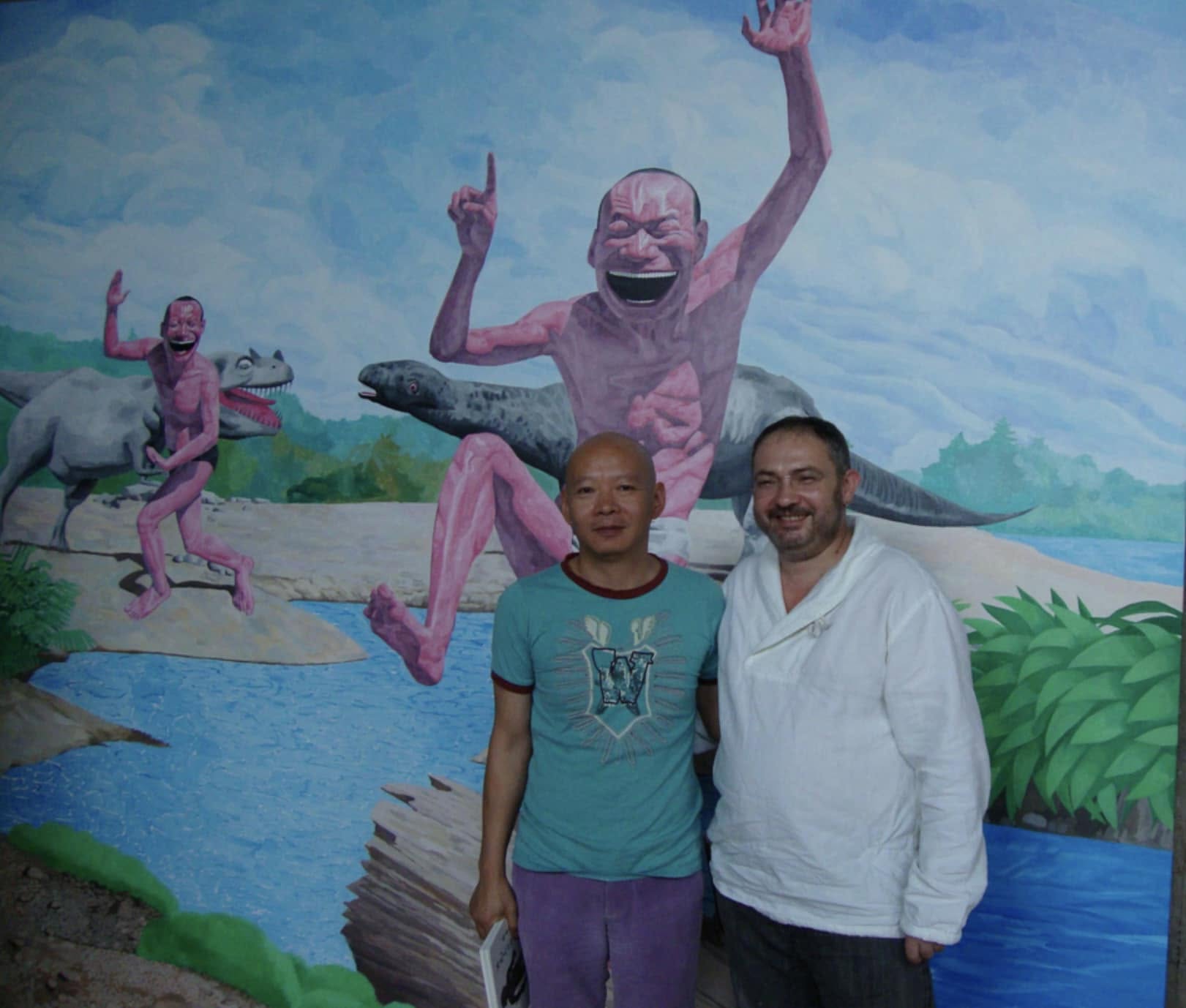
P.S. In the photo is my first meeting with Yue Minjun; we will soon be participating in the same exhibition in Basel.



