
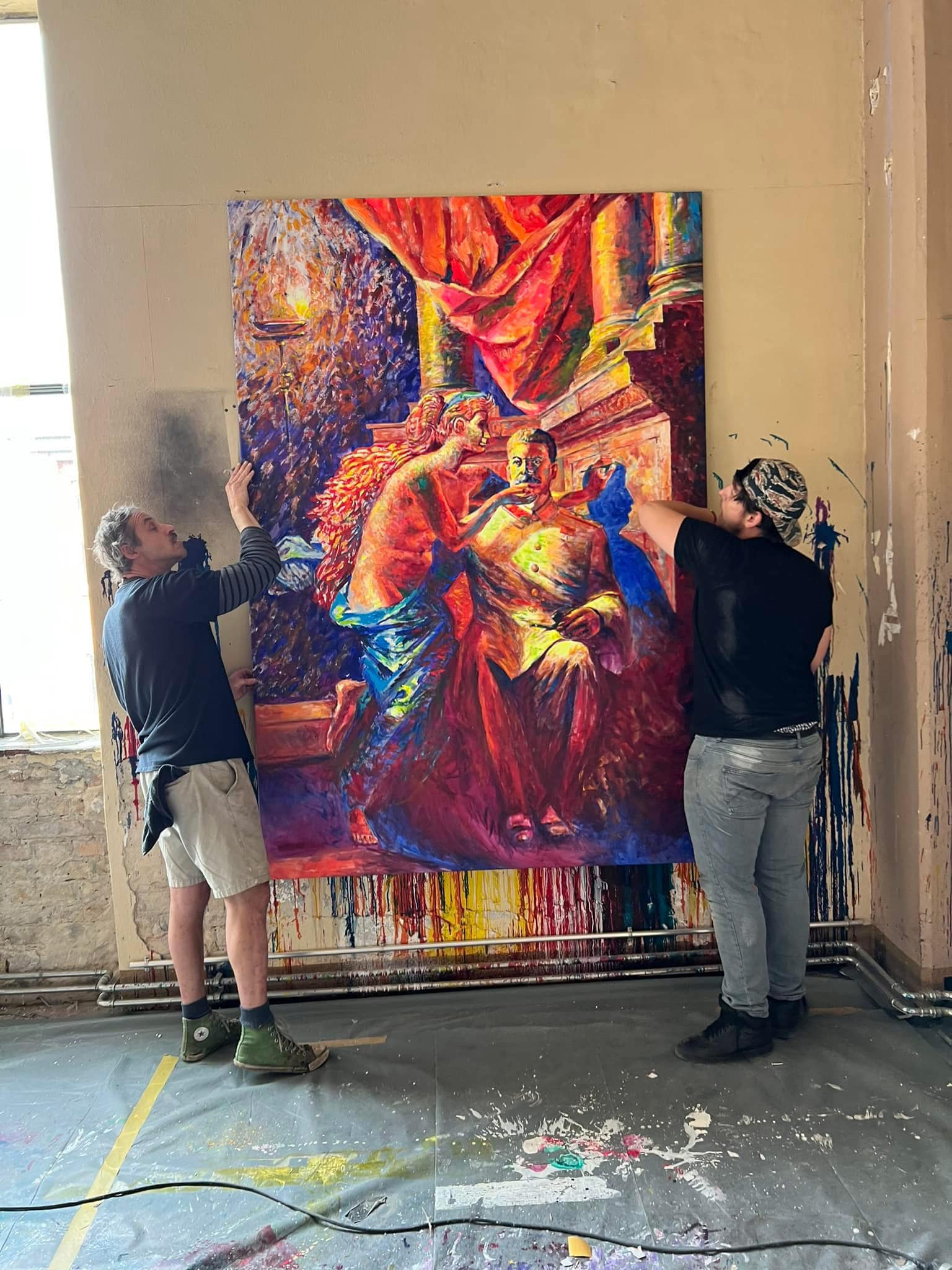
This text is unscheduled. And it's not that it is particularly useful, but since the topic pops up constantly in the comments, I will speak out. It is customary to scold the market. At best, to treat it as an inevitable evil. What are the grievances?
Surely I missed something. And surely for each of these grievances there are confirming examples. Alexander Brener drew a dollar sign on Malevich as a protest against the market. Malevich died in poverty and illness, while art dealers make millions on him. Manzoni mocked the market by selling artist's shit. Maurizio Cattelan provoked the market by selling a banana on duct tape. Banksy built a mechanism for destroying the painting at the moment of its sale. The Palto Gallery (Alexander Petrelli) parodied the market. And of course, Van Gogh symbolized the blindness of the market.
First, I'll tell a story. In 2005, I was doing an exhibition in New York at the Chelsea Museum. And I met a strange man. He was deliberately looking for a "Russian" as he had heard about Russian oligarchs buying art. He himself is an engineer, worked in some city services. In the garage of this guy lay a huge and magnificent mural by Keith Haring. Once, Haring created it for a hospice or an orphanage for children with AIDS. New York is being rebuilt, and this building was supposed to be demolished. There were several publications in the newspapers that, inevitably, one of the most important artifacts of the city would perish.This new acquaintance of mine is not a collector, not an art lover, and not even a rich man. But he found out how much much smaller works of the artist cost, developed a special frame for the wall out of metal structures (he said it cost him about 20,000 dollars), dressed the wall in it, and moved it to his place.Later I found out that he sold it somewhere to the Emirates. I was particularly fascinated in this story by the fact that the person knew nothing about the artist, was not interested in art, and generally was such a—well, primitive, dollars in his eyes. But he preserved a masterpiece for the future. This is the work of the market.
There is another story. When during a fire in a house, the servants were the first to carry out the art, because they had heard the conversations of the owners and knew that it cost a lot of money. And probably there are many such stories.
On the other hand: the French king, a patron of the arts, fascinated by the talent of Leonardo da Vinci, gives him a lifetime pension in one of his castles. And Leonardo, deprived of the need to earn money, does not create a single work during these three years.
On another hand, the guild system, when artists are part of an artel and receive a stable salary, leads to the fact that "one-type production" is driven out, and although everything is made by hand, essentially it is an edition. A good artist is the one who works faster, not more interestingly.
On another hand, the Soviet system of supporting artists (which sometimes fascinates their European colleagues) quickly turns into the dictate of some artists over others—and most often the untalented over the talented.
On another hand, state grants lead to the fact that the artistic environment is silent and does not speak out on sharp topics, and this is at best. More likely, it will be forced to glorify war and the bosses.
The market gives freedom. Money received for a work of art does not oblige the artist to anything, unlike grants and salaries.
Importantly, the market follows art, not the other way around. I remember perfectly well the moment when artists started using digital photo and video technologies. Initially, the market rejected them. But as a result, the Gelman Gallery sold a huge amount of video by the Blue Noses. The AES+F group, selling prints of digital works, is one of the most successful.
This does not mean that there are no problems. But these are not problems of the market; they are problems of the artistic environment. The post-industrial economy has released people to engage in creativity in large numbers. There are much more of them than is necessary for society. The market works with a redundancy of supply—and not by a factor of two. In New York in that same year of 2005, there were 100,000 artists, and 2,000 exhibited in galleries (and half were not even New Yorkers). Of course, "not by market alone," but everyone strives there, hence a competition unseen in other spheres.
P.S. In the photo is a work by Alex Melamid. He believes that one artist is generally enough. Well, since we worship one God, and most of us have the same phone, Apple, why this "imposed diversity." Melamid repainted a large number of works (including his own) in the style of Van Gogh and calls on all artists to drop their ambitions and humbly draw in this style, since the people love it.



