
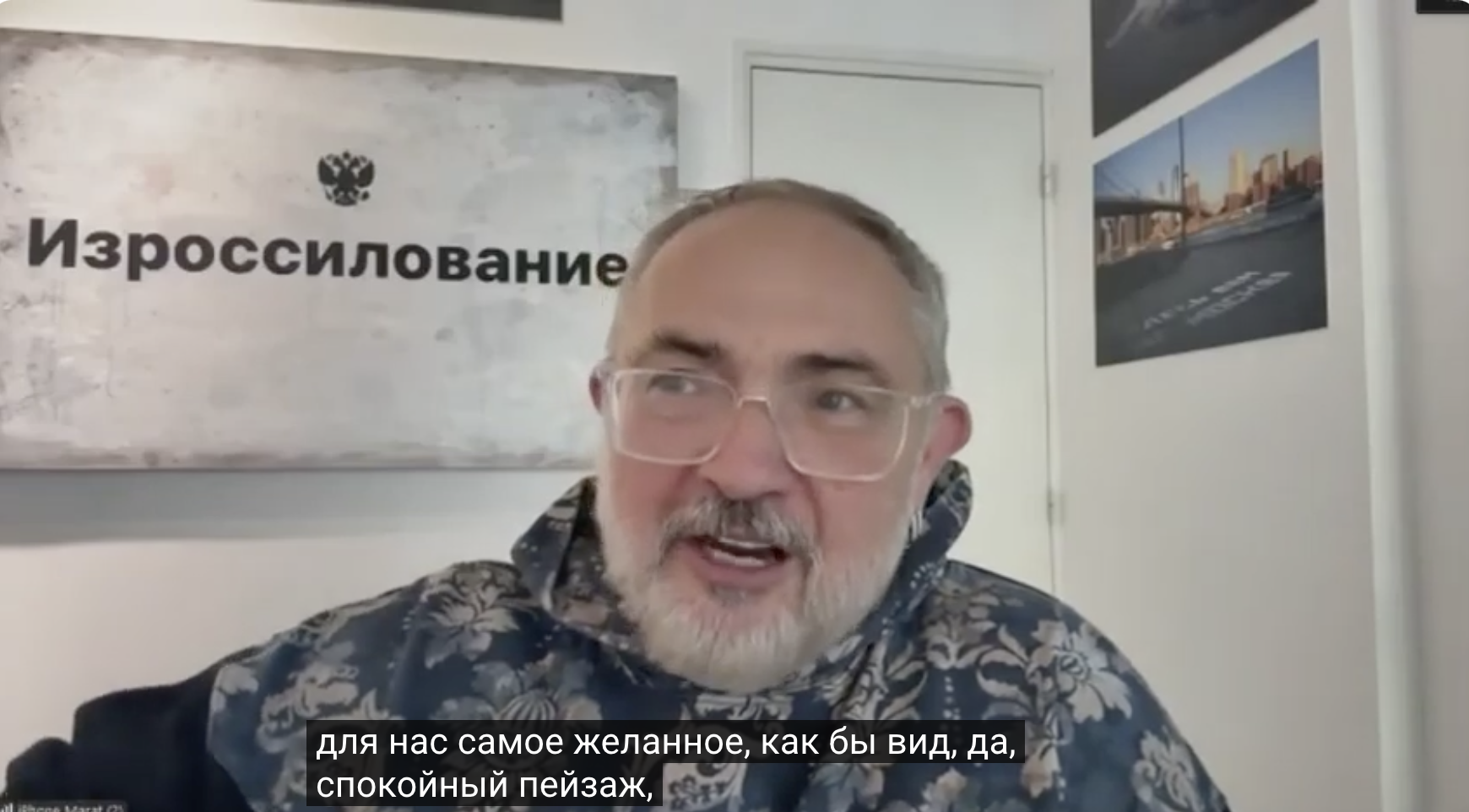
Host: Good afternoon, dear friends. We have a spectacular guest with us today. You undoubtedly know his name, even if you missed him on one of my previous programs a couple of years ago. This is Marat Guelman—collector, gallerist, former museum director, and, more recently, an artist. He is the creator of highly compelling paintings that we will be discussing today.
First, a quick heads-up: Marat is speaking to us live from Brussels, where he just opened a brand-new gallery literally yesterday evening, European time. He is sitting right inside the gallery, and much of the setup is still being ironed out. So, if we experience any connectivity hiccups, please don't blame him or me. We are on the cutting edge of contemporary art, and technical glitches happen on the front lines. So, Marat, good afternoon. I’m thrilled to see you. You look quite mission-ready today. How did the opening go?
Marat Guelman: Good afternoon. It went wonderfully. Brussels is not just Belgium; it is the capital of Europe. This is where the European Parliament is located, which is precisely why we chose to open a gallery here. The art we show will be predominantly political. This isn't my personal commercial gallery; I am acting here as the art director. It is an initiative of the Anti-War Committee of Russia. We launched yesterday with an exhibition by the artist Philippenzo. He is a highly prominent young creator who previously made waves inside Russia. You might have encountered his work; he did a famous street-art piece titled “Our Son” (Syn Nash). He is a stark, explicit anti-war artist. Naturally, he no longer resides in Russia; he lives in Vilnius. We opened with his solo show. The layout is exceptionally convenient for creators: it spans three floors, and the third floor houses two bedrooms.
Host: Ah, so you envision this not merely as a gallery, but as a sort of residency house for artists?
Guelman: Exactly, it will operate as a full cultural center. Not just a gallery space, but a cultural hub. Since artists will be traveling here, they will be able to live right on-site.
Host: Got it.
Guelman: We harbor massive plans. We intend to feature not only Russian artists but also American and Chinese creators—sharp, explicitly anti-totalitarian art. It will serve as a dedicated sanctuary for alternative Russian culture outside of Putin's jurisdiction. It is going to be a highly vital venue.
As for Berlin, where I am primarily based, and Montenegro... well, it turns out that these past two years—even though I am no longer a young man—have been perhaps the most prolific of my entire life. That includes my work as a curator. Beyond Brussels, we have a gallery in Belgrade. The day after tomorrow, on May 1st, we are launching a major new exhibition there featuring Vladimir Sorokin.
Host: Wow.
Guelman: We also operate a cultural center in Montenegro. We host a residency program there where artists come to live, work, and exhibit for two months. And in Berlin, I run my private gallery called Guelman & Unbekannt. That space is entirely dedicated to digital art, the quest for new creators, new mediums, and the exploration of the "new".
Host: Fascinating! This is the perfect moment to discuss how you transitioned...
Guelman: And across all these galleries, I...
Host: How you became an artist yourself! This is an incredibly gripping topic.
Guelman: We can bypass my ancient, amateur attempts from when I was 13 or 20 years old. This recent transition crystallized due to two primary catalysts. The first and most critical trigger occurred when Putin began using the nuclear button as a tool for geopolitical blackmail. There was a specific juncture where things weren't progressing well for his military on the front lines, and the international community began providing Ukraine with serious military hardware. He started threatening everyone, asserting that if his back were pushed against the wall, he would blow up the world, that he would press the button.
I was already living in Berlin, and journalists and politicians frequently asked me: "What do you think? Will he actually do it?" On one hand, I cleanly comprehended that he is sufficiently unhinged to press it—a delusional old man who has nothing left to lose and is entirely willing to drag the rest of civilization into the abyss along with himself. On the other hand, if I constantly validated that narrative in public, I would be playing right into his hands. He wanted figures like Guelman sitting in Berlin, terrifying the Western public with statements like: "Oh, he's about to press the button, everything is about to blow up."
I began contemplating: what do I do in this scenario? I refuse to deceive people. And then I realized there was only one way out: to visually demonstrate that we harbor no fear. If a dictator like Putin uses nuclear weapons as a weapon of blackmail, he is blackmailing society, blackmailing entire sovereign states. The unique mechanism to combat blackmail is to manifest absolute fearlessness. So I began generating these beautiful landscapes, punctuated by nuclear mushroom clouds.
Host: Now let me share my personal perception. When I walked into the gallery—and friends, let me log this right away, you can view this exhibition yourself in New York at the Ethan Cohen Gallery. The venue is located at 251 West 19th Street in Chelsea, right off Tenth Avenue. It’s an exceptional building. You won't even notice it’s a commercial gallery from the street; you just look for building number 251. You step inside, and they direct you right in.
Once you enter, you find yourself wrapped in a classic white-cube space. And hanging on these white walls are exceptionally vibrant, cheerful pictures of diverse formats, executed in completely alternative fine art styles. We will walk through them in a moment. But the primary takeaway is that they are intensely joyous. The first thing that popped into my mind was the iconic film, “Dr. Strangelove or: How I Learned to Stop Worrying and Love the Bomb.” Marat Guelman has taught us to treat this paradigm with a certain lightness—or at the very least, to laugh at it.
Guelman: I simply recalled myself at ten years old, when I first realized that I was mortal. Initially, it was a deeply dark, depressive realization, but over time, that friction dissolved. The concept of “memento mori”—remember death—became a baseline principle of my life. It never precluded me from loving, rejoicing, or having fun. It simply means you always remain aware that life is finite.
I thought that just as a skull or a candle traditionally serves as a memento mori, this nuclear mushroom cloud can operate as a symbol that civilization itself is finite. We must relate to it exactly in that manner. After all, death stands alongside love as one of the twin paramount themes of art history; some of the most sublime masterpieces ever created are dedicated to it.
I realized we must execute this shift on a societal level. Paradoxically, by doing so, we push back the literal end of civilization. The moment an individual smiles while gazing at a nuclear mushroom cloud, Putin loses a fraction of his power. That is my core conviction. A blackmailer ceases to be powerful the moment the target stops fearing him. That is the foundational concept.
I want to showcase these images now. Look at this wall in one of the gallery rooms. There are several exhibition spaces spanning alternative levels. This is just to give you a structural sense of the variance in dimensions. As you can see, the mushroom cloud is ubiquitous. Now let's examine a few specific works up close.
For those who understand art history, the stylistic pastiches are instantly recognizable. Let's move to the next slide. This is the largest painting in the exhibition. It doesn't fully translate on a small screen, but it is deeply monumental and exceptionally beautiful. It is executed in the style of the premier contemporary German painter, Gerhard Richter. The subsequent work steers us into the aesthetic of the American Pop Art master, Roy Lichtenstein—and again, the core centerpiece is the exact same mushroom cloud. Moving forward, this piece functions as an explicit nod to ancient Egypt; it looks like a mural that could easily adorn a sarcophagus.
Next up, we see the primitivism of Henri Rousseau. The images, as you can observe, are highly vibrant, beautiful, and visually attractive—the kind of piece you would gladly hang in a living room. Moving along, an art enthusiast will instantly recognize the fluid manner of Henri Matisse. In this instance, the mushroom cloud is elegantly pushed into the background, functioning almost like an organic element of the landscape.
The subsequent piece is exceptionally beautiful: Claude Monet. Monet's aesthetic is channeled across several paintings. Let's look at another one. Here is an alternative pastiche of Claude Monet. It is almost a total visual quotation, if you subtract the mushroom cloud hanging directly over the bridge.
We have a couple more. I am intensely fond of this one, though I cannot recall off the top of my head the exact prototype we utilized to anchor it. It depicts New York wrapped in a deep, inky indigo. It is profoundly expressive. People are inquiring about the pricing; we will unpack that shortly.
And finally, two more works. One is a near-direct quotation of an Ilya Kabakov painting that many of us know intimately. Let me remind you that Guelman was among the primary figures who pioneered exhibiting Kabakov's works extensively. And the final one is a beautiful, highly precise rendering of a J.M.W. Turner landscape. For an art lover, walking through this exhibition is practically a guided tour through the history of Western art—though a curated one. The showcase houses roughly 100 works. Some are titled simply “Bomb No. 5,” “Bomb No. 3,” or “Bomb No. 1.” Occasionally, the captions include parenthetical notes like "parody after Andy Warhol" or "after Kabakov," and so forth. In other instances, there is zero textual guidance—you are expected to guess the reference yourself.
Now that our audience has observed a fraction of this exhibition, we must unpack the core mechanics.
Guelman: The exhibition features only a small portion of what we produced because the physical gallery space is relatively intimate. Effectively, we mapped out an entire alternative history of art. It is vital to note that this exhibition was created by me in co-authorship with a specialized group of technological artists operating under the moniker “Plus-Minus Comma” (Plus-Minus Zapryataya).
Host: Plus-Minus Comma.
Guelman: These are primarily tech-artists, engineer-artists of a completely new archetype. They engineered a specialized artificial intelligence model and trained it extensively on explosions—on mushroom clouds. They trained it on raw detonations, and together we forged an alternative history of landscape painting.
As we immersed ourselves in this project, I realized it unlocked a deeper secondary meaning: the rehabilitation of the landscape genre. The human eye loved consuming landscapes long before the birth of formal art. A landscape addresses our innate love for the horizontal. It is our most primal desire—a calm view, nature. But clearly, over millennia, the genre has been reproduced to the point of exhaustion. For me, it was a joyous revelation to discover that the nuclear mushroom cloud could function as a compelling pretext to return to landscape painting. So, yes, we effectively mapped out a history of the landscape, actualizing the genre.
Furthermore, we aim to definitively close the book on the epoch of pastiche and postmodernism via this project. When people ask me what kind of new art this is, I respond: "This is not new art; this is the final page of the old art."
Host: Exactly. Meaning, artificial intelligence acts as the catalyst that concludes the epoch of postmodernism in art, because AI itself is the ultimate manifestation of the postmodern methodology.
Guelman: Exactly. And therefore, yes, I ambitiously believe that my co-authors and I are summarizing and drawing a definitive line under an entire cultural epoch.
Host: I have a question that is critical for me and our audience: the creative process itself. We keep tossing around terms like artificial intelligence, computers, specialized training, and so forth. Where does the workflow begin, how does it evolve, and what constitutes the final output? Break down the components for us; it will aid our collective education.
Guelman: Look, the fundamental paradigm—and this applies not strictly to working with AI, but to all digital art since the 1990s—is that it has forged an entirely new methodology of collaborative labor. Traditionally, when Vitaly Komar and Alexander Melamid worked together, they were two artists who trained in the exact same institution, the Stroganov School, under the same academic framework. They were literal clones of one another who could step in for each other—one paints, both sign the canvas. That represents a traditional duocentric model of a shared artistic enterprise.
The modern model of creative consolidation is what we call a collaboration, where every single member of the team executes a highly specialized task. First and foremost, one must comprehend that artificial intelligence delivers a completely new archetype of the artist. In the pre-historic era when we grew up, if a child was born, the family spent years agonizing: "Is he a techie or a humanist? Should we enroll him in an art school or an engineering academy?" Today, an artist is obligation-bound to be both a techie and a humanist simultaneously. Harmony is generated via mathematical formulas, coding, and generative art; formal permutations are executed via manipulating numerical series. It is vital to understand that a new archetype of creator has entered the arena. I label this the "Leonardo archetype"—he engineered complex machinery...
Host: Yes, a unified engineering and creative intellect. Understood. So the workflow begins, let's say, with your core conceptual idea. You format the concept and hand it over to your team. You operate with three engineers, correct?
Guelman: Unquestionably, yes. A conceptual framework is the baseline anchor, and it must be coupled with a distinct personal stance. When you are working with an artificial intelligence platform that is theoretically capable of executing absolutely anything, the paramount question becomes: why?
Forgive me if I am drifting slightly from a direct response, but I want to methodically outline this new landscape. Look at classical art: the primary question was what was depicted—the Last Day of Pompeii? Modernist art shifts the primary question to how—how was it depicted, what is the form, and so forth? Subsequently, postmodernism enters the arena, shifting the question to who executed it—focusing on the author's specific position or identity. And currently, when artificial intelligence can simulate even human thought processes, the absolute paramount question becomes: why? Today, in the wake of AI, you can only generate meaningful art if you possess a definitive answer to why you are creating it.
Host: Yes.
Guelman: So I didn't merely pitch an abstract idea. I consolidated a group of allies who share my conviction that a geopolitical blackmailer must be systematically disarmed. And it turns out that art executes this function far superiorly to political journalism or even a man wielding a rifle. The moment a group of creators aggregates around the question of why, the subsequent phase unfolds.
The primary flaw of modern, commercially available AI models is their aggressive universality. If a model is universal, it is conceptually faceless. Consequently, we engineered our own proprietary AI model that is deliberately non-universal—it is hard-coded to possess specific "flaws." We understand that Marc Chagall's formal flaws—his anatomical distortions—effectively forged his distinct visual language.
When we launched this project, AI agents didn't exist in their current format, but a corporation opened the source code for their model, Stable Diffusion. They permit you to engineer your own bespoke AI architecture on top of their code. Look at how that physical process unfolds: you grab a universal system, figuratively slice off half of its brain, and instead of that missing data, you jam it full of nuclear detonations. We trained an AI model that is deliberately distorted; from a universal standpoint, it is entirely nonsensical and "maniacal"—it perceives a nuclear blast in absolutely everything. If you show it a photo containing a random cloud, it mutates it into a mushroom cloud; it mutates a tree trunk into a nuclear detonation. It operates as an AI maniac.
Training this maniac is the most labor-intensive, grueling phase of the entire enterprise. Once that is finalized, the workflow shifts into pure pleasure. You begin to fantasize and permute: "Oh, I love Henri Rousseau. Let's run a Rousseau pastiche. Now let's blend Andy Warhol and Mark Rothko." What constitutes the output? It turns out spectacular. In the works where you cannot instantly pin down the stylistic lineage, we were explicitly playing with stylistic cross-pollination. We forged a proprietary style out of distinct, calibrated proportions of Gerhard Richter, Mark Rothko, and Andy Warhol.
The third phase is strict curatorial selection.
Host: Yes, because a machine can generate an infinite volume of permutations.
Guelman: Exactly. The history of art is massive, and not all permutations are successful. Consequently, the workflow shifts into an expert editorial sorting process—extracting the masterpieces, selecting the finest iterations out of a colossal volume of generated files.
Following that is a highly fascinating phase: translating these digital images into physical material. We utilize a specialized secondary AI model that scales a small digital image into a high-resolution file. This isn't a crude digital enlargement; it populates the gaps, ensuring that the simulated brushstrokes appear completely as if executed by a human hand.
Host: By a human hand, yes.
Guelman: And finally, there is a dimension that few people notice today. Everyone is hyper-fixated on the software evolution of AI, yet they fail to track the parallel evolution of robotics and 3D printing.
Host: Yes.
Guelman: We don't want people consuming this art strictly via screens. When you walk into the Chelsea gallery, you encounter actual, physical paintings hanging on the walls. Even if you step up incredibly close and examine the texture under a magnifying glass, you will perceive that while it isn't traditional oil impasto, it looks completely like a real painting from a normal viewing distance. Today, machines exist that are no longer mere flatbed printers—they physically spray acrylic paint onto canvas. The process replicates physical painting, it is simply automated.
We worked on this for roughly a year, and our curated archive currently houses 1,000 completed works.
Host: Wow.
Guelman: Yes. It maps out an entire alternative trajectory of art history, from ancient Egypt to the present day. This became my inaugural project as an auteur. I am currently directing several distinct creative projects, but this series centered on nuclear detonations is the most high-profile.
Host: Now that you have outlined the mechanics, let's address the commercial question that our audience immediately logged: how much do these pieces cost? Since this is a commercial Manhattan gallery, what can be acquired there and at what price points?
Guelman: Every single work exists strictly as a unique edition—a monoprint. But since our underlying philosophy dictates delivering art into every home, ensuring that everyone possesses the capacity to hang a nuclear explosion in their living room...
Host: And admire it, yes.
Guelman: We offer smaller graphic works priced between $600 and $800. The large-scale canvases sell for $7,000 to $10,000.
Host: So the price spectrum is wide. I am certain your Gerhard Richter pastiche sold instantly. The Richter, the Lichtenstein, and the Warhol are likely gone.
Guelman: And the Matisse, too.
Host: I would gladly acquire the Matisse myself, but we must pivot to a brief commercial break, friends. I promise it will be short. Let me remind everyone that our guest today is Marat Guelman, and we are unpacking the art of yesterday, today, and tomorrow. Stay with us.
(Commercial break)
Host: Welcome back, dear friends. Our guest today is joining us live from Brussels, straight from a brand-new gallery that launched just yesterday, dedicated entirely to political art. Marat Guelman, who curated this inaugural exhibition, will provide us with the exact physical coordinates so our friends traveling to Brussels can visit the space.
Marat, welcome back. Where exactly is the Brussels gallery located?
Guelman: The gallery is titled Perm Gallery. Perm.
Host: A deliberate nod to your tenure as the director of the PERMM Museum of Contemporary Art, where you executed so many progressive initiatives. It seems you intend to continue that trajectory on European soil.
Guelman: Exactly. The Anti-War Committee established this gallery. We wanted the branding to send a dual signal: on one hand, that it was forged by Russians; on the other hand, that it represents alternative, anti-war Russia—not Moscow, and not the Kremlin. That is how the name materialized. It bridges directly back to the museum I used to direct. The physical address is 149 Rue Antoine Dansaert. You can locate us instantly via Google Maps or Facebook by searching for Perm Gallery. It sits right in the center of Brussels. We will be exhibiting not strictly Russian art; the focus will remain continuously on political art, including American political art.
Host: So you are constantly traveling globally right now? Beyond exhibiting your own works, you are analyzing what is unfolding across diverse art hubs.
Guelman: I would say that my activities as a cultural producer and producer currently consume far more time and mental energy than my personal artistic practice. That’s just the reality of managing several galleries. For instance, the day after tomorrow, a major milestone will unfold in Belgrade. We operate a gallery there managed by my wife, Anastasia, called Nova Reznica. We are hosting the opening of Vladimir Sorokin’s solo exhibition, titled “Materia.”
Host: Is that an extension of the Sorokin exhibition we witnessed in New York two years ago?
Guelman: It is a completely distinct exhibition, though structurally similar in that it consolidates Volodya's manual graphic works alongside his large-scale paintings co-created with artificial intelligence.
Host: This steers us right back to the topic of artificial intelligence—a deeply complex, non-trivial phenomenon. We touched upon the question of collective authorship. You noted that today, the defining parameter is knowing why you are creating art, and that the modern workflow requires a synthesis of engineering minds and creative humanists—the physicists and lyricists finally locking arms.
Let me remind our audience that the New York exhibition at the Ethan Cohen Gallery (251 West 19th Street, Chelsea) runs until May 30th. You still have plenty of time to visit and perhaps acquire a piece. As Marat outlined, the price points range from $7,000 for the large canvases down to $500–$700 for the graphic prints. Even if you don't purchase anything, it is fascinating to analyze these works, tracing the classical lineages of the past and comparing them to these new cycles.
A question popped into my mind regarding contemporary artists. Claude Monet is firmly historical, but Gerhard Richter is a living contemporary master. How do you navigate copyright and intellectual property when working with AI? Where is the boundary separating plagiarism from creative appropriation? How do you resolve this?
Guelman: Look, first and foremost, artificial intelligence trains on the works of past artists in the exact same manner as any student enrolled in an art academy. Every single creator initially absorbs the cultural data that pre-dates them, stands upon the shoulders of giants, and subsequently executes their own step. In that structural sense, AI introduces nothing novel to the creative paradigm.
Regarding the distinction separating derivative, secondary art from conceptual appropriation: it boils down to the presence of figurative "quotation marks." When you aren't attempting to conceal your stylistic borrowing, but conversely choose to explicitly manifest it as a deliberate homage and a token of deep respect toward the source material... We inhabit an era where the cultural output of the past functions as a collective luggage—a shared landscape. You play within this landscape, constructing your own vision not by frantically searching for a novel form, but by articulating why you are configuring it.
Nonetheless, I don't exclude the possibility that a specific living artist might view things through an alternative lens, assuming that we are exploiting their intellectual labor, and choose to file a lawsuit. We are absolutely prepared for that scenario. When you register an account and connect to an AI platform like Stable Diffusion, you sign a hard terms-of-service agreement. Under that contract, you own the full copyright to any outputs generated via your prompts.
Consequently, if a scenario materializes where Gerhard Richter resolves to sue Marat Guelman, the actual legal defendant won't be Marat Guelman; it will be Stable Diffusion—the corporation that engineered the software. I will simply produce the contract demonstrating that I hold the legal copyright granted to me by Stable Diffusion, and the lawsuit will be forwarded to them. Extensive legal precedent already exists defining the boundaries of borrowing, quotation, and fair use. Think of Jeff Koons being sued over a sculpture pastiche of a commercial toy, or Andy Warhol being sued by the photographer whose shot he utilized to print his Che Guevara portraits. This question possesses a long legal history. Culture is a shared topography. If a traditional painter sets up an easel to paint a landscape containing a tree, and a man steps up to him declaring: "Hey, that is my physical tree, you cannot paint it..."
Host: I catch your drift, yes. The tree belongs to the property owner, but the view of the tree—the landscape—is universal heritage. Twenty artists can set up easels side by side to paint the exact same view.
Guelman: Exactly.
Host: This is a magnificent explanation. Since you observe the art world from multiple entry points simultaneously—as a producer, a collector, a dealer, and an author—let's address the macro view. When we met previously, you noted that a few years ago, it felt as though everything had already been articulated in art, that we had reached a dead end...
(A phone rings in the background)
Guelman: Forgive me, I am receiving a call.
Host: Someone is eager to speak with Marat. Let me remind our viewers that he is joining us live from Brussels, straight from a gallery that launched literally yesterday, so technical and communication disruptions are part of our frontline reality. While he reconnects, let me reiterate the location of his solo exhibition in New York: 251 West 19th Street, Chelsea, running until May 30th.
Marat is back with us for the final minutes of our program to answer a burning question: what does the future hold? Marat, the floor is yours.
Guelman: I can map out the historical pivot that every contemporary artist and curator is navigating today. For a long time—perhaps the past 40 years—it felt as though nothing genuinely new could materialize in art. This mirrored Francis Fukuyama's philosophical thesis regarding the "End of History." Within the art world, the consensus dictated that the "new" was impossible; everything had already occurred. Artists occupied themselves not with discovering a new epochal current, but with carving out their bespoke, hyper-individualized niche.
And then, three macro-events transpired that I believe systematically broke that paradigm, foreshadowing the birth of the "new."
The first catalyst, paradoxically, was the coronavirus pandemic. For two years, the global art community spent every working day glued to computer screens, and we finally looked close enough to truly discern the value of digital art. Previously, the establishment viewed it with deep snobbery due to a lack of academic expertise, structural gatekeeping, and capital markets. The pandemic systematically forced a re-evaluation. As I outlined, we discovered a completely new archetype of the artist there, and new criteria. A colossal digital continent merged with the mainstream market.
The second event was a conventional land war breaking out in the center of Europe. This crisis shattered the false construct of the "End of History." The war returned narrative and a deep interest in storylines to contemporary art. Throughout the modernist epoch, Russian art was routinely shamed by Western critics: "Why are you constantly telling us stories? Why are you trying to instruct the viewer? Art is supposed to create a formal aesthetic atmosphere." But war is a literal storyline. The most compelling art emerging out of Ukraine today belongs to the diary genre, where creators consciously strip away formal ornamentation for the sake of strict, raw documentation.
And the third catalyst is artificial intelligence, which mutates everything, including the creative paradigm—to a far greater degree than the invention of the camera once did.
The convergence of these three historical events within an exceptionally narrow window of time is the precise reason I resolved to step onto the field as an artist. I spent 40 years working within a professional art system where the "new" was deemed impossible. When a historical turning point arrived unlocking the birth of a new era, what was I supposed to do—retire? No. I resolved that I wanted to participate in this new era in a fresh capacity: as an artist. We are living through an intensely sharp historical moment. I am not alone; there is a consolidated global core of perhaps 50 to 100 individuals and groups actively seeking the language of this new art.
Host: This is profoundly compelling. You mentioned the camera, and it reminds me of how you previously outlined that the birth of photography systematically forced a mutation in fine art, splitting creators into distinct camps. Elaborate on that thesis for our audience; you formulate it best.
Guelman: I believe we have about three minutes remaining, correct? When the camera emerged as a mechanical device capable of instantly documenting physical reality, artists split into three unequal camps.
A small core—perhaps 5%—rushed to embrace the new medium, integrating the gadget into their workflow. Edgar Degas used photographs to study ballerinas; others painted directly on top of photos, or utilized photography as a radical new language, like Alexander Rodchenko. Those artists won. Historically, they and their artistic descendants forged modern glossy journalism and the entirety of Hollywood.
A second group, also relatively small, declared: "Since a machine can document physical reality, we will completely abandon documentation; we will venture into the exploration of pure form." They won as well. They and their descendants forged the entire universe of modernism and contemporary art.
However, the vast majority of traditional artists lost. These were the traditionalists who asserted: "The emergence of this mechanical gadget has zero relevance to us. We converse with the divine, we engage in High Art, and this is merely a cheap piece of iron. We are painters; we work with our hands." They continued painting conventional academic portraits and landscapes, and they systematically vanished into cultural oblivion.
My point is simple: you possess the absolute right to be a skeptic of artificial intelligence, or you can choose to be an enthusiast. The only fatal mistake is attempting to pretend that artificial intelligence has altered nothing.
Host: And on that definitive note, Marat has disconnected. Let me remind our audience that Marat Guelman was speaking to us live from Brussels—and perhaps he will return for a final wave. There are zero Wi-Fi networks fully established in the new gallery yet; they have internet access, but as you observed, the connection flickers. However, since we are both intimately familiar with the material—he with his personal art practice, and I with what I gathered during our conversations—our dialogue was executed at a highly sophisticated level.
Let me reiterate that his solo exhibition, “First of all, it's very beautiful,” runs until May 30th at the Ethan Cohen Gallery in Chelsea, Manhattan (251 West 19th Street, between 9th and 10th Avenues). It sits on the ground floor of a residential building. Once you step inside, you enter a classic white space populated by highly vibrant, joyful paintings punctuated by a singular unifying element: the nuclear mushroom cloud.
As Marat outlined, the series aims to remind us that while civilization and our individual lives can conclude at any given second, that realization shouldn't paralyze us with fear or prevent us from living fully. Together with the tech-artists of the Plus-Minus Comma group, he engineered a curated history of the landscape genre through pastiches of Monet, Matisse, Warhol, Richter, and Kabakov. Some works are already sold, but options remain available at various price points.
Thank you for staying with us, friends. Until next time.



