I started writing the main text about artistic quality, and it's somehow big, and clearly I won't finish it today since we decided to drive to Berlin from Belgrade by car. Therefore, today quickly a few tips to artists regarding prices, and tomorrow already a full-fledged text:
Initially, the price depends on the gallery in which you exhibit. I would see to it that the price was no less than a square meter of housing. For example, in Montenegro—2 thousand euros for a painting of medium size. Be sure to provide for the possibility of raising the price: either in a year or after the sale of 60% of the exhibition. Often the agreement with a gallery is based on a mutual understanding, verbal, if there is trust. But talk everything through. Most importantly, discuss the termination of cooperation.
Until you sell 20 works on this market, agree to discounts easily. After 20, raise prices by 30–50%. Keep in mind that for works worth up to 5,000 euros, regional markets do not intersect. Therefore, different prices in different countries is OK.
Make the first catalog from the second exhibition so that the dynamics are visible. Be sure to include in it those works that have already been sold. This stimulates collectors to follow your career—and therefore, intentionally or unintentionally, help it.
Participate as actively as possible in non-commercial projects, especially in those where there is a budget for production. Big careers (and therefore big prices) are created not by galleries, but by museums and non-commercial projects. Non-commercial art is often expensive art.
The formation of the price and the formation of the value of a work are processes that, although not coinciding, intersect. If good art, highly valued by professionals, is called "non-commercial," it simply means they do not see the market in which it can be sold. Look for another seller and/or another way of monetization, another market.
At any opportunity, expand the geography of exhibitions, even if it requires expenses and is less profitable. All sad stories on the market are connected not with economic crises, but with its narrowness and locality. If necessary, take upon yourself the transportation of works, but definitely be present in several cities. Minimum in three cultural capitals, your works must be in the storage of one of the galleries.
The price is always the result of the sum of communications and efforts of different people: critics, curators, gallerists, consultants. See to it that their number does not decrease. Do not perform these roles for yourself, even if you do it well. If you write well, write articles about other artists; if there is an inclination toward curating, do not participate in your own exhibitions. The more people are involved in professional activity around you, the closer success is.
Participate only in charity auctions. Remember that at a regular auction, your works compete with the works of classics whose fame is much higher. At a charity auction, a peak price for your work is possible.
Be honest. Call repetitions repetitions, and better yet, do not make them without special need. Well, for example: you are 70 years old, you are doing a retrospective, and you can no longer get hold of a part of the works—you lost track of them or simply museums won't give them. Only in this case is a repetition justified. The art world seems immense only at the beginning of a career. Over time, you realize that everyone touches everyone else. An artist has the right to a reputation of an eccentric, a lazy person, a misanthrope, a person with a terrible character—all this will be tolerated for the sake of your talent. But just not cheating.
The number of works on the market is important. Here it seems that everything is clear—the fewer works, the more expensive. But this applies only to very famous artists. For artists in mid-career and beginners, it is the opposite: the more works, the more successful he will be, and therefore more expensive. Each new collector (or museum) who bought a work becomes, in a certain sense, an advertising agent for the artist. There are 300 museums in the world that have works by Russian artists. You must keep these collections in mind as a kind of goal.
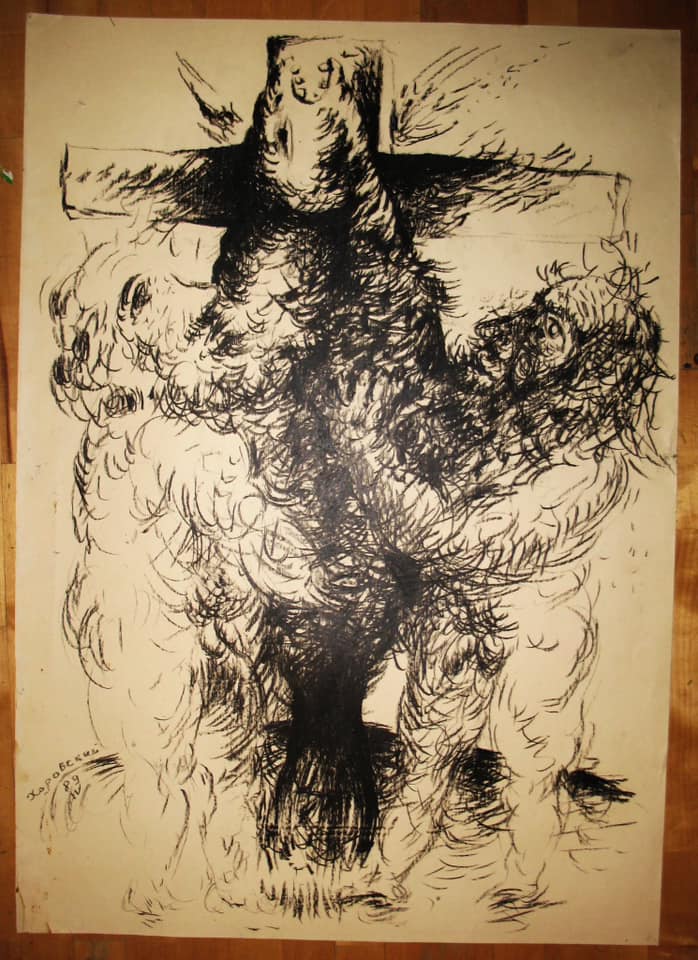
P.S. Traveling through my life. In the photo is the last purchase: I bought several sheets of graphics and a sculpture by Yura Khorovsky from the late 80s. This is a Moldovan artist—the first with whom I had an agency agreement. Even before the opening of the gallery.