I decided that the post with answers should also be integral and possess some independent value. Therefore, it will be about our communication.
I want you to be sure: my posts are written from the position of an expert who is maximally well-disposed toward the audience, an unbiased expert who has no other goals than to create content useful to artists and thus make it popular. Of course, if as a result, in addition to sought-after texts, a group of like-minded people appears, it will be a great success, but I do not set such a goal for myself.
In a certain sense, this is a demonstration that I have despaired of influencing the situation in which we found ourselves (war, now wars, forced emigration, participation in the anti-Putin resistance) and am looking for more solid ground. A sphere in which I feel confident.
I feel confident in two spheres:
In what is called "cultural policy": how everything is set up, and why. Here I rely on my experience and observations of other actors.
In what is called "artistic policy": what kind of art corresponds to the moment. Here I act as a self-confident type, a practicing investor, curator, and artist.
In the first case, I expect clarifying questions. Perhaps I did not formulate my thought clearly enough, or missed some aspect. But I do not expect polemics. Especially this kind:
Nothing matters except big bucks.
Nothing matters, look at how it used to be.
Who do you think you are anyway?At the same time, please formulate questions so that the answer is interesting not only to you. Then a detailed answer is guaranteed. Moreover, I am interested in the prompt from your side—in an occasion to pontificate.
In the second case, in the case of "artistic policy," I can be deliberately polemical. Even provocative. But so far, this has been expressed not in texts, but in the images accompanying these texts (specifically accompanying, not illustrating). Here I am ready to argue, possibly agreeing with someone else's correctness. Well, and generally, there can be many different artistic policies.Please do not play Socrates here, but simply state your vision, what you disagree with in mine, and do not decorate this disagreement with a series of "leading questions." It is annoying.
There is also a third block of questions concerning me personally, and the main one among them: why does Gelman write so ungrammatically? I answer: I have an acquired dyslexia. It happened like this: my mother wanted me to be 16, not 17, when I finished school, so that before I was drafted into the army there would be two years to enter an institute. To do this, she sent me to school at the age of six. But this was possible only through connections. She had connections in a Moldovan school, although in the family and in the yard we spoke Russian. Therefore, for the first year and a half, I studied in a language I poorly understood.Later, when I was transferred to a Russian school, it turned out I had fallen behind everyone. I easily caught up in all subjects except writing, and since then it's been like a block with languages.Of course, I could give texts to someone for proofreading so as not to embarrass myself, but I like to write a text and publish it immediately. I am glad for pointers to specific errors and correct them with gratitude. But keep in mind that comments like "Gelman, write grammatically" are pointless.
Let us move on to the questions.
Dmitry Kedrin:What can you say about those cases when an artist opens a gallery named after himself and engages in self-promotion, exhibiting his own works in it?
An artist is in any case an entrepreneur, not an employee. He must promote himself into the world one way or another. But success is always the result of the sum of communications and efforts of different people: critics, curators, gallerists, consultants. See to it that their number does not decrease. Do not perform these roles for yourself, even if you do it well. If you write well, write articles about other artists; if there is an inclination toward curating, do not participate in your own exhibitions. The more people are involved in professional activity around you, the closer success is.
Petr Bankov:Marat, what do you think, cities are turning into "museums" with a "change of exposition" in street art, for example—does this change the paradigm of the two points museum-gallery?
There will be a separate text about the place of the artist in the post-industrial economy, but within this framework, I draw attention to the fact that the city is the most natural partner for an artist out of the existing triad: business, power, territory.I simplify to a scheme: Business asks "make it beautiful for me," "entertain me"; Power asks "glorify me," "be loyal to me." The artist can do both, of course, but often does not want to. And what does the city want? "Let my residents have quality leisure. Let there be lines for exhibitions, rather than drinking in back alleys" or "create such an event that the media write about us, and then tourists and investors will come to us." But the artist himself would like lines to stand for his exhibitions and the media to write about them. Interests coincide. Plus, look at the center of the city, its face? On the right is a theater, on the left is a museum, straight ahead is a park. That is, the face of the city and the infrastructure of art are one and the same. In the future, every small town will look for its own Gaudí.
Alex Alexeev:Where does the "Artificial Intelligence," now a real player in art, belong? How does it relate to other markets?
Artificial Intelligence is a tool, of course, not an actor. But a tool that "changes everything." It possesses qualities that conflict with the currently existing market and its fetishes:
Generating a new work is very easy. Well, that is, today the market rests on the fact that there are "unique works"—which are created by relatively large efforts in a single copy—and "limited editions"—editioned works, which, understandably, cost less and are not unique, even if the edition is limited. Artificial Intelligence provides a third position—variation. With the speed of producing an edition, I can generate unique, formally distinct works. In the future, this is an undermining of the salon market.
Today, authorship is the main fetish of the market. It was correctly noted here that the "high market" resembles a market of brands. The artist's name is the determining criterion of the price (there will be details in the text about prices). Artificial Intelligence calls authorship into question. Who is the author? The one who wrote the prompt? The one who created the AI? The one who trained the agent on the basis of AI? The author of the concept? Or the one who selected one option out of a dozen?
You can write a text and get an image. That is, the third fetish of the market—craft, handiwork, school—also becomes optional.
Tan la:Thank you very much, Marat. Such an analysis is very useful and needed. We await the continuation. If possible, not in such an analytical, but in a simpler language... Very good, serious art competes poorly with commercial art. What should such artists do, where should they move, if only for the sake of a name?
Well, and there are many questions and comments about "bad commercial" versus "good non-commercial" art. There will be a text titled "Apology of the Market," in which I polemicize a bit with such a division and talk about the invaluable assistance that the market provides for art. Commercial art is primarily that which is adapted to understanding. But this does not mean at all that it is bad. It is SIMPLE. For example, old art is literally ALL commercial. What does this mean? Was it good and became bad? No, it became understandable.The commercialization of art will become clear in a comparison of two plots:
I bought a work by a famous artist to decorate my bedroom. His art did not become worse because of this, and he did not become commercial.
I invited an artist and asked him to make a work similar to the one I saw from him, but of a different size and so that it matches the tone of the curtains in the bedroom. This is commercialization.That is, it is bad when the Market interferes in the process of creating art, rather than when it uses ready-made art. And a total disaster is when the artist foresees the client's request and immediately makes works for the bedroom.
But this is a simple answer to a complex question. I will be writing an apology of the market.
Faina Grimberg:Why are wonderful artists dismissively called "Native Speech"? Because they are classical Russian artists? Because it is unconditional art?..
No, it is professional slang, connected to the fact that the works of these artists illustrated the 4th-grade textbook Native Speech in the USSR. For many, this was actually the first contact with art. The artists are good, but the people who limited their knowledge to "Native Speech" are the subject of my irony.
P.S. Here Marina Koldobskaya wrote her classification of artists in response to my post. Well, curious. And Yuri Gordon wrote his in response. And each explains something to us, and leaves something unexplained. Usually, when an artist speaks about art "in general," he speaks about his own art. For example, if Anatoly Osmolovsky says "art must be political," it means that he imposes such requirements on his own art. If Koldobskaya says that artists are of three types: priests, decorators, and manipulators, it means she herself is such to a certain extent. I thought that many artists have such a non-scientific system of ideas about art. This can also be shared in the comments, and this too will get into the book. Naturally, with the indication of authorship.
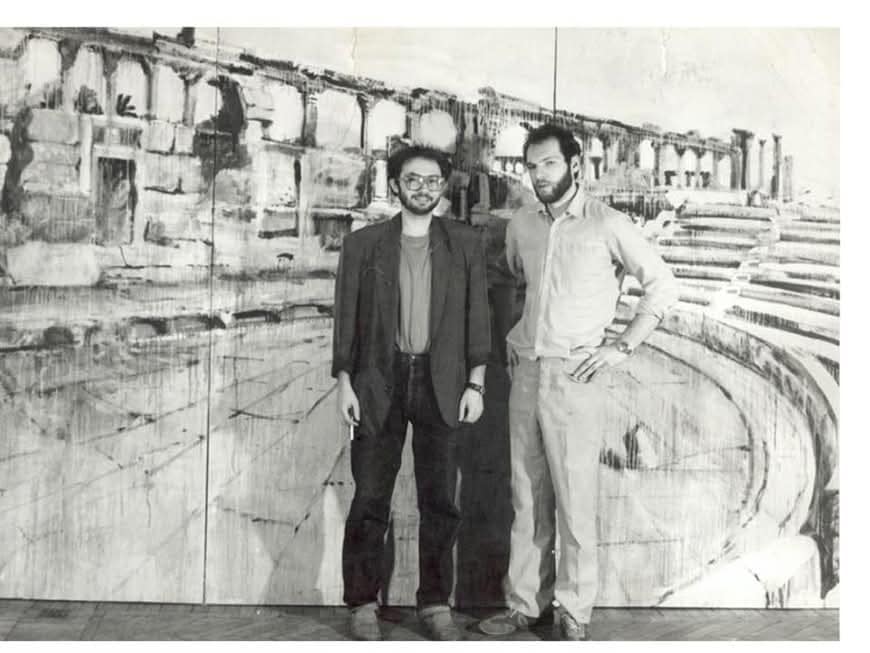
In the photo, this is me with Valera Koshlyakov. Exactly half a lifetime ago.