
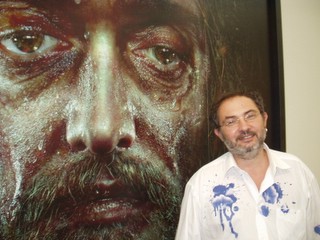
The Protagonist's Backstory
Igor Shevelyov: You can begin an intimate conversation with someone from almost any starting point—say, how their parents met or divorced. Or your recent appointment as Deputy General Director of ORT, which quite literally shocked the Moscow scene. Or the fate of your gallery. Yet I would like to start with a turning point that probably shaped the life of every forty-year-old in our country: the moment the country itself broke apart. In other words, what were you doing before and after Perestroika?
Marat Guelman: If we take 1986 as the turning point, that was the year I left state service. I was a senior research fellow at an institute, and one fine day I simply walked out and never went back.
Shevelyov: In Moscow or St. Petersburg?
Guelman: No, in Chișinău. The interesting part of my pre-Perestroika life was studying at the Telecommunications Institute in Moscow. For all five years of my studies, I worked in the theater as a stagehand.
Shevelyov: Which theater?
Guelman: Various ones—at the Moscow Art Theater (MKhAT) and the Mayakovsky Theater. On one hand, it was a side job; on the other, a second education. Back then, the theater was the vital center of life in the country, so I wanted to be right where everything was happening.
Shevelyov: Did your father—the playwright Alexander Guelman—play a role in that?
Guelman: Obviously, getting into that circle with my father's help was easier for me than for almost anyone else. But that created a different complication. My father's authority, and simply being "Guelman's son," meant I felt I wasn't allowed to be ordinary. That tormented me for quite a while. Until I was about twenty-three, it seemed urgent that I do something to step out of my father's shadow. Naturally, the first thing that comes to mind is writing. Nothing successful came of it, however.
Shevelyov: Did you write prose?
Guelman: Yes, prose and plays. The initial impulse is understandable: to replicate my father. That brought more torment than joy, and there was nothing to boast about. Then, in 1986, the first shoots of a new era appeared—the Centers for Scientific and Technical Creativity of Youth (NTTM).
Shevelyov: As I understand it, those weren't merely shoots, but incubators of the future from which more than one future oligarch hatched.
Guelman: We held a competition in Chișinău, won it, and I became the academic secretary of an NTTM Center. A completely different life began. First, there was freedom from bureaucratic routine. Second, there was suddenly serious money by the standards of the day. A man who had previously earned two hundred rubles—out of which he paid alimony and rent—suddenly makes twenty or thirty thousand in just a few months!
Shevelyov: In 1986?!
Guelman: Yes. The Center earned the money, and you had complete discretion over how to allocate it. I spent my very first earnings on collecting art.
Shevelyov: Local art from Chișinău, from the south?
Guelman: No, I had a clear vision that you had to go to Moscow for art. Since I had studied in Moscow, later while working in Krasnodar and Chișinău, I rushed back to the capital at the slightest opportunity. And when residency permit restrictions loosened in 1987 and free movement became possible, I relocated to Moscow almost immediately.
Shevelyov: Did you still have an old circle of acquaintances here from your institute days or theater work?
Guelman: No, a completely different life began. For some reason, my life always seems to start from a blank slate. Cooperatives replaced the NTTM centers. Since my background was in systems programming, I could operate independently. Someone somewhere would sign contracts and take their cut, but ultimately everything came down to the person who actually knew how to do the work and collected the fees for it. I was selling my brains while simultaneously continuing to buy art.
Then 1988 arrived, and after the Moscow Sotheby's auction, prices for Russian art shot straight up. Continuing to collect on the old terms became too expensive. So instead, I began offering services to artists: organizing exhibitions and helping them negotiate contracts. In return, they continued selling me works at pre-Sotheby's prices. By 1990, I found myself practically the only person equipped to do this professionally.
Shevelyov: When did you become the first to open a gallery?
Guelman: The first private gallery; corporate ones already existed. More importantly, on one hand, the Artists' Union collapsed overnight, reduced to a mere landlord of a few buildings, while no alternative infrastructure or trained personnel existed. It was an ideal vacuum. On the other hand, collecting teaches you fast: when you spend your own money, you want to understand what you are buying, otherwise you end up with worthless junk. That is how you become an art expert.
Shevelyov: An expert in contemporary, marketable art?
Guelman: I would say contemporary in the sense of art being created today. How did the global art market shift after World War II? Previously, the key figure on the market was the expert of the past. Because old masters were traded, the most vital specialist was the one who could verify authenticity, establish attribution, and identify historical movements. In the postwar era, movements began shifting with kaleidoscopic speed. The problem of authentication vanished because the living artist was standing right there, and prices began climbing. A Jasper Johns bought for seven thousand dollars sold three years later for a million and a half.
The crucial skill became discerning which artist's work would gain value over time and who to invest in now. The figure of the gallerist emerged as someone who predicts the future—someone who started working with an emerging artist five years ago who is now a star. Demand arose for experts who understood current artistic processes—work born before our eyes that had a chance of entering the future. In 1990, I founded the M. Guelman Gallery, and an entirely new life began.
Dramatis Personae
Shevelyov: You've already mentioned starting a "different life" multiple times. How many have there been—three, four? Or is it one life with variations?
Guelman: I don't think I am a man of a single destiny. I started out as a dancer in the Joc folk dance ensemble before university. Back then, I thought that was how life ought to be—you got to travel abroad. Later, during my studies, under the spell of the theater, I tried to replicate my father's life. My third life—the hardest—lasted until 1987, when there were simply no visible prospects ahead. And my fourth life began in 1990 with the gallery and the art world, when everything became so absorbing that it consumed me two hundred percent.
Shevelyov: Surely there was a subconscious drive to conquer the world, to contribute something uniquely yours, to expand your cultural mission as far as possible?
Guelman: Chance plays the leading role in my life. Even though my professional work constantly involves designing projects and strategies, I have never engineered my own life. I have always tried to seize whatever accidental opportunities came my way, saying yes to every offer. Up to a certain point, that worked. Naturally, once success arrives, the volume of offers exceeds your capacity, forcing you to turn things down and start planning—deciding what you want and what you don't. Yet right up until 1997, I tried to realize everything life put in front of me. Some things worked out and some didn't, but there was no master plan.
As for art, there are two aspects to it. First, it is a passion that predated my collecting. Second, whatever else you do in life, you eventually have to answer the question: Why are you doing this? Only art exempts you from that question. You don't have to justify it. It is self-sufficient; its purpose resides entirely within itself. That is another reason it captivated me. Like many people, I have no answer to the question of the meaning of life, and the beauty of art is that no answer is required. Everything grew from that—the collecting, the gallery. Whatever else I pursue, art remains a vital core of my life.
Shevelyov: Yet your engagement with contemporary art gravitated toward social practice and inevitably ran into politics. Eight years ago, when we first met, you used to say that the Kremlin, as a center of power, didn't need to be stormed...
Guelman: ...Rather, it needed to be governed from an art gallery.
Shevelyov: Something like that—relocate the center of power elsewhere, and the Kremlin would empty out. Nevertheless, we are witnessing your gradual entry into the Kremlin.
Guelman: No, I think that misreads my intent. I have never been in politics, and I am not in it now. There are simply things you do better than others, and—again yielding to the flow of life—you apply those skills where they are needed. You are referring, of course, to my involvement in election campaigns.
Shevelyov: Yes, for starters.
Guelman: Look, an election campaign requires a politician not merely to change their style of behavior, but to alter their entire system of human relationships.
Shevelyov: What do you mean?
Guelman: During an election, a politician needs creative people—for advertising, design, copywriting, and scriptwriting. Before a campaign, a politician interacts either with bureaucrats—the executive vertical—or with fellow politicians and politicized citizens. During an election, they must work with journalists, ad executives, and artists.
Shevelyov: Normally, those people act as hired staff. You, however, elevated this into the grand presence of a creative conductor. Just as you previously introduced the persona of yourself as gallerist, have you now imposed the persona of "political curator" onto the public consciousness?
Guelman: Artists, designers, ad makers, and journalists are the people upon whom a politician's electoral success depends. Yet they do not operate within a "boss-and-subordinate" hierarchy. They are rarely anyone's disciples or fans; they observe everything critically and from the outside. As it turned out, my gallery experience working with artists—the ability to build productive workflows with inherently ungovernable people—proved to be in high demand.
It began with me leveraging my connections in the art world to help produce visual campaign materials: posters, design, advertising. Later, it became clear there was an even more crucial function: acting as a translator between the language of bureaucrats and politicians and the language of creative people—knowing how to set a task and ensure it gets executed.
Shevelyov: Couldn't one say that this specific role came into existence with you?
Guelman: No, that role always exists in complex projects of this scale; perhaps my background in the art world simply made it more visible. Along the way, I realized I actually share certain traits with my father—specifically, a dramaturgical, scenario-driven mindset. There are plenty of experts capable of analyzing a static situation, but very few who can construct a narrative arc from one situation to the next and foresee how it will evolve. You often catch yourself essentially writing a play. You have a setting—whether it's 16th-century France or late 20th-century Russia—and a cast of characters, and you try to envision what happens next. Perhaps that playwright's instinct turned out to be useful as well.
Flitting from Light into Shadow
Shevelyov: Being in demand always implies being present in circles where your skills are valued. How did you enter that circle?
Guelman: My entry there was also somewhat accidental. I wanted to help my brother, who had just graduated from university and was considering a career in political science. By then I was already a well-known gallerist, so I organized several roundtable discussions to help him break into that environment, inviting all the prominent political analysts of the time. That was when I met Gleb Pavlovsky and Sergey Kurginyan. My roundtables were well received, leading to joint projects that eventually evolved into my partnership with Pavlovsky in the Foundation for Effective Politics (FEP).
Shevelyov: Allow me to bring the conversation full circle to your latest move: joining ORT as Deputy General Director. Many link this to preparations for upcoming elections. Do you have a overarching mission here—such as building civil society in Russia, making individual elections merely stepping stones—or are you simply adapting to the situation, whatever it may be?
Guelman: Imposing a grand ideological mission—using ORT as a vehicle for "all things good"—is not on the agenda. First, what attracts me is teamwork. Mostly, I have executed projects solo; right now, I am excited about working alongside Konstantin Ernst and Alexander Lyubimov. Second, I view ORT as a media business. Bringing personal ideological agendas into a business is foolish. The priority is making the business more effective.
Shevelyov: Yet recall Vladimir Gusinsky's NTV, where business was also paramount: help the authorities win an election, and they grant you commercial preferences. Wasn't that a business model that ended in ruin?
Guelman: The media business is built entirely on audience trust. Today, ORT is the leading television network in the country—people watch it and trust it. Consequently, that trust must be continuously earned. The channel needs to articulate a clear, credible stance across all issues to justify that trust.
Shevelyov: To differentiate itself from competing networks—RTR, NTV, TVS?
Guelman: Yes, clear positioning, including within the competitive television landscape. You must hold a distinct position, and the audience needs to feel it. ORT is the nation's premier public broadcaster, meaning its stance must largely be shaped by society itself. Yet speaking the truth requires more than just the resolve to say it—you first have to know it.
What Ernst and I discussed—and what is genuinely needed—is building an analytical system that equips journalists and production teams with the most comprehensive briefing possible on every vital issue. In other words, my job is to do the behind-the-scenes groundwork. Do you follow?
Shevelyov: Not entirely. Are you talking about a research institute?
Guelman: We won't build an institute, though we will certainly collaborate with several. We will establish an expert council and create a dedicated mechanism for briefing those who need the data. Actually, come to think of it, let's not dwell on plans and the future right now.
Shevelyov: Too early?
Guelman: Yes. My personal life is one thing; collective corporate work is another. You have to accomplish and demonstrate results before talking about them. So let's return from plans to life itself.
Shevelyov: How did you enter the television circle, another new sphere for you? Chance again?
Guelman: Yes, as always—chance and good personal relationships. Naturally, running political campaigns brings you into contact with television. Actually, let me frame it differently. Starting in 1995, alongside running the gallery, I began working as a consultant. Everything connected to the gallery and art belongs to my public persona, whereas everything tied to consulting is strictly non-public.
Shevelyov: Meaning part of you retreats into the shadows?
Guelman: It isn't even shadows; it's simply a private sphere. It is a service industry—you are serving clients.
Shevelyov: Like a doctor bound by medical confidentiality?
Guelman: More like a lawyer than a doctor. Yesterday someone told me about a speechwriter for President Bush who was fired because his wife casually mentioned in an email that her husband had coined the phrase "Axis of Evil." In politics, what matters is will. Everyone knows a politician doesn't write their own speeches, yet they choose the writers, set the direction, edit the drafts, and ultimately decide whether to deliver the words.
In our world—among journalists and artists—the concept of authorship, of who invented or phrased an idea, is paramount. In politics, political will is supreme. What counts is not who drafted a law, but who championed it and voted it into force. The same applies here: this analytical work is fundamentally non-public. On television, there is the visible layer—the broadcasts, hosts, and journalists who serve as the face of the network—and there must be the hidden groundwork supporting them, which is currently lacking. The task of the analytical directorate is to provide that foundation so that when news breaks, the journalist stepping into the story is fully equipped.
Shevelyov: Does that mean certain developments will be forecast and prepared for in advance?
Guelman: We will establish a workflow that ensures journalists receive qualified analytical support for their reporting.
Shevelyov: Serving the political will of a single candidate is straightforward. What constitutes the "will" of a network like ORT?
Guelman: That is a good question—you have to intuit that will. On one hand, you operate in a commercial environment where you must constantly justify viewer trust so people don't change the channel; you rely on sociological tools and ratings for that. On the other hand, every network claims a distinct niche. ORT is, broadly speaking, a public channel, whereas RTR is a state channel. Perhaps the task is simply learning to articulate the will of the majority and embracing it as the channel's own editorial stance.
Shevelyov: Will you personally introduce new directions for cultural programming on the network?
Guelman: I imagine that will be unavoidable—you always gravitate toward areas where you have deep expertise. However, I must stress that this was not assigned to me as a priority. The primary focus is the media business. An audience is far too valuable an asset to gamble with; introducing something new, even with the best intentions, carries the risk of losing viewers. I think the network's current strategy of shifting cultural programming to late-night slots is sound—the niche audience interested in art and culture tends to be night owls. Still, there is much to learn, and it will be far easier to speak about this after at least two months on the job.
The Years Incline Toward Harsh Truth
Shevelyov: Don't you feel that you—an "aesthete, brother to a hooligan"—are gradually turning into a bureaucrat? Already there are things you feel constrained from discussing openly. Isn't freedom of expression a vital sign of inner freedom?
Guelman: It probably takes some time to feel like a true bureaucrat, though I will admit right away that the prospect intrigues me.
Shevelyov: A new uniform for yet another life?
Guelman: No, it's something else. There are things a person can accomplish solo—not many, perhaps, but within them you enjoy total freedom. Right now, working inside a team and a major corporate structure appeals to me precisely because it involves a different system of human relations. I feel a need to evolve; perhaps my entire generation is shifting.
Within solo achievements, you eventually hit a ceiling. There is a fundamental difference between my gallery in 1996 and in 2002. Back then, Russia's entire contemporary cultural life rested on a handful of private galleries where sprouts of freedom and the most exciting work emerged. Today we are in a different phase: major institutions have stepped in, and state museums have begun engaging with contemporary art. I simply do not command the resources of the Tretyakov Gallery or the Russian Museum.
Shevelyov: Is it easier for the Hermitage to partner with the Guggenheim than for Guelman?
Guelman: Yes. Previously you operated as an individual persona, a solo unit. Now, the era of institutions is arriving. And then there is age...
Shevelyov: A forty-year-old's midlife crisis?
Guelman: For anyone working in the arts, turning forty is just one of many crises endured over a lifetime. Frankly, I've had creative crises every three months—constantly suspecting I'm doing everything wrong.
Shevelyov: Then what is driving this shift?
Guelman: The crucial shift is how your relationship to that personal freedom changes. You discover a distinct joy in being part of a team.
Shevelyov: Aren't you afraid of becoming a pawn in someone else's game? Are you free to walk away at any moment, or do you genuinely feel you are among your own team?
Guelman: With Konstantin Ernst and Alexander Lyubimov, we are the same age and speak more or less the same language, backed by a long history. Even back when Konstantin was producing his earliest shows, my gallery was a subject of his interest. When the offer came, I suddenly realized how much I craved that dynamic. Operating inside a large organization delivers an entirely different kind of adrenaline.
I remember when Vasily Shakhnovsky left Mayor Luzhkov's administration to join Yukos, he told me: "You know, working inside a major corporation is a completely different sensation." And it truly is. This coincided with my stage of life and my decision to step back from FEP, where the evolving internal dynamics no longer interested me.
Shevelyov: Doesn't that mean you essentially jumped off a moving train, switching teams mid-stride?
Guelman: No, it's a different situation altogether. At FEP, I was a co-owner, Gleb Pavlovsky's partner. That was like running a publishing house or a gallery—everything emanated directly from you, just alongside a partner. This is different: ORT is an institution that existed before me and will exist after me, owned by shareholders, governed by a board of directors, where I am stepping in as an executive manager. It brings a different feeling—a fresh challenge, a genuine shift in life, and, by and large, a test.
Shevelyov: What does it give you—money, social standing, a new sense of self?
Guelman: I would put it this way: it offers the opportunity for transformation. I am accustomed to my life turning nearly 180 degrees every seven years, and my sense that life is moving in the right direction is closely tied to that renewal—to knowing that everything ahead will be different.
Shevelyov: Do you have a clear vision of how things will unfold from here? Most people lie awake at night worrying about a new chapter ahead—or do you possess a dancer's Zarathustrian psychology: amor fati, loving fate and living purely in the moment?
Guelman: That is a tough question. I hold a conviction that you must seize the opportunities chance places in your path—it is a kind of faith. Imagine someone who climbs steadily toward success; they generally understand the mechanics behind their achievement. In my life, despite all the strategic planning I do professionally, every major turning point has been the result of sheer coincidence.
Shevelyov: So plans get tossed aside?
Guelman: My plans have always run parallel to reality. When I parted ways with FEP, I had one set of plans, yet something entirely different materialized. My father has a great saying about this: "I never fiercely defend my convictions because I know I'm nearly seventy, and my views change every five years. Why argue when I'm certain that in five years I'll see things a bit differently?"
The same applies here. It is hard to talk about rigid plans when coincidence constantly reshapes the board. Of course, in hindsight you can calculate how much was luck, how much was personal merit, and how much was someone else's will. Still, my experience shows that when life throws down a challenge, you should try to accept it—to the fullest extent possible.


