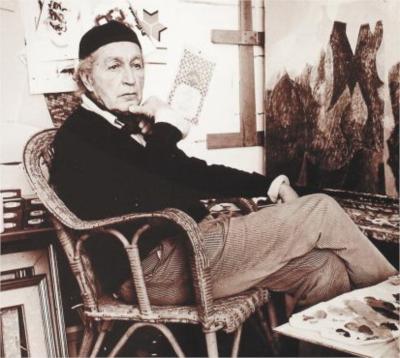
Gabriel Spat (born Shloyme Patlazhan) was a masterful painter and caricaturist whose career was defined by his evocative watercolors and intimate observations of urban life. Born into an artistic family in Chisinau, he moved to France in the 1910s to join his brother, Nyuma. His early years in Paris were marked by extreme poverty; unable to afford full canvases, he began painting on small scraps provided by other artists. This necessity shaped his lifelong expertise in miniatures and small-scale works, which would later become his artistic trademark.
In the 1920s, he adopted the pseudonym SPAT and became a significant figure in the French cultural scene. He collaborated with cinema pioneer Louis Delluc and published the acclaimed caricature album "Stars of the World Screen" (1923), featuring vibrant portraits of icons like Charlie Chaplin and Mary Pickford. However, his true passion lay in the streets of Paris. His delicate watercolors of boulevards, parks, and the banks of the Seine captured the vibrant, "impressionistic" atmosphere of the city, eventually catching the attention of major galleries in New York.


The outbreak of World War II added a somber, documentary depth to Spat’s work. While living through the occupation, he produced a poignant series of watercolors titled "Germans in Paris." These works, depicting German parades and the stark reality of wartime life, were later published in the New York Times and exhibited in Manhattan, serving as vital visual testimonies of the era. In 1945, Spat permanently settled in New York, where he officially adopted "Gabriel Spat" as his legal name and continued to exhibit across the United States and Canada.
Until his passing in 1967, Spat remained a bridge between the artistic traditions of the School of Paris and the American modernist scene. His works are celebrated for their free brushwork, vibrant colors, and the ability to capture monumental moods on a miniature scale. Following a 1971 memorial exhibition in Paris, his legacy continues to be honored in international collections, cementing his reputation as a refined observer of the human condition across two continents.























.jpeg)