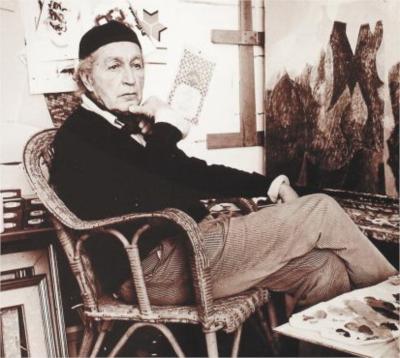
Nahum Gutman was a foundational figure in Israeli art, a visionary painter, illustrator, and mosaicist who literally shaped the visual identity of modern Tel Aviv. Born in the Jewish agricultural colony of Telenesti in Bessarabia, he moved to Palestine with his family as a child in 1905. His early artistic education began under the guidance of Ira Yan, followed by studies at the Bezalel School of Fine Arts in Jerusalem. There, he studied under Boris Schatz and Abel Pann, absorbing a tradition that blended classical training with the nascent "Palestinian style"—a unique synthesis of Orientalism and Art Nouveau.
In the 1920s, Gutman embarked on a formative journey through Europe’s artistic capitals—Vienna, Paris, and Berlin. During this period, he became a sought-after illustrator for the giants of Hebrew literature, including Chaim Bialik and Saul Tchernichovsky. Upon his return to Tel Aviv in 1926, he became a central figure in the city’s burgeoning modernist scene, designing sets and costumes for the innovative "Ohel" (Tent) Theater and eventually creating the official coat of arms for the city of Tel Aviv.


Gutman’s versatility was extraordinary. For over thirty-five years, he served as the primary illustrator for the children's publication Davar Leyaldim, where his playful yet sophisticated drawings mentored generations of young readers. His ability to capture the spirit of the era was equally evident during the 1948 War of Independence, during which he produced a poignant series of portraits of soldiers for his album "How It Was." Later in life, he mastered the art of mosaic in Italy, returning to Israel to adorn public spaces with monumental works, most notably at the Herzliya Gymnasium and the fountain on Bialik Street.
By the time of his death in 1980, Nahum Gutman had left behind a monumental legacy that spanned painting, literature, and ceramic sculpture. He is remembered not just as an artist, but as a "painter of the people" who captured the light, the architecture, and the pioneer spirit of a new nation. Today, the Nachum Gutman Museum of Art in the Neve Tzedek neighborhood of Tel Aviv stands as a testament to his enduring role as a founding father of Israel’s cultural heritage.



















.jpeg)