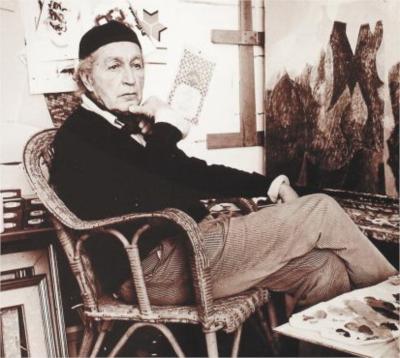
Samson Flexor’s artistic journey began with landscapes of his native Bessarabia, but by the 1920s, he had shifted his focus almost exclusively to portraiture, evolving toward a distinct expressionist style. His international career took off in 1927 with a solo exhibition at the Campagne Première gallery in Brussels, followed by prominent group shows in Paris. During World War II, while serving as a partisan in the French Resistance, he produced a series of powerful expressionist-cubist depictions of the Passion of Christ—a theme influenced by his earlier conversion to Catholicism.
In 1948, Flexor left France and settled in São Paulo, Brazil. Inspired by the city's burgeoning urbanism, he rapidly pivoted to geometric abstraction. In 1951, he founded the legendary "Atelier Abstração" in his home in the Vila Mariana neighborhood. This studio-school became a vital nexus for Brazilian modernism, nurturing a generation of artists such as Norberto Nicola and Alberto Teixeira. Flexor’s teaching emphasized personal expression over rigid doctrines, fostering a lyrical yet disciplined style that bridged European modernism with the burgeoning Brazilian constructivist tradition.


The São Paulo Art Biennial (Bienal Internacional de Arte de São Paulo) is the largest international exhibition of contemporary art in Latin America, attracting worldwide attention. Founded in 1951 with reference to the Venice Biennale, it was a model for the art exhibitions held in Venice. The festival's goals were to introduce Brazilian society to world art, particularly American and European, to allow Brazilians to see the works of renowned contemporary artists firsthand, to promote Brazilian artists' international recognition, and to transform São Paulo into a regional art center. Since 1957, the festival has been held in the Sicilio Matarazzo Pavilion in Ibirapuera Park, designed by a team of architects led by Oscar Niemeyer and Hélio Uchoa and offering approximately 30,000 square meters of exhibition space. From 1951 to 2008, the Biennale, like its Venice prototype, featured national chapters and a main, international project led by a renowned curator or group of curators. However, in 2010, the national chapter format was abandoned, deemed outdated and insensitive to the complexities of mutual cultural influences in the contemporary world.In 1961, Flexor opened a second abstractionist studio. In the final years of his life and throughout the 1970s, Samson Flexor's works were regularly exhibited in Brazil, and in recent years, interest in his work has also grown internationally.
Posthumous recognition steadily grew, and Flexor's paintings entered renowned international collections. An exhibition of one hundred of the artist's paintings, "One Hundred Years/One Hundred Works," was also held in 2007 in his birthplace at the National Art Museum of Moldova in Chișinău. From there, it traveled to Bucharest in October and then, following the artist's life's journey, to Brussels, London, Paris, Rio de Janeiro, and other Brazilian cities.




















.jpeg)